Tradewing vs. Disco: Finding the Right Engagement Platform
The association conference isn’t going anywhere. But today’s members increasingly expect ways…
September 4, 2026
If you are running an organization, you know that you need to keep your members engaged to have them stay for the long haul. As expectations for stronger digital connections rise, traditional engagement methods are quickly falling behind.
In this guide, we will cover the basics of modern member engagement and walk you through ways to upgrade your engagement strategy to build a vibrant community.
Here is a breakdown of what we will discuss:
Without further ado, let’s dive right in!

Modern member engagement is a unified, measurable, year‑round digital infrastructure that powers participation, professional learning, peer networking, and non‑dues revenue growth across an association’s ecosystem.
In addition to the functions of a legacy AMS, such as managing the membership database, renewals, and payments, community engagement is also quickly becoming something that associations can leverage to boost retention and revenues.
Tradewing, with its unified engagement infrastructure, consolidates community, learning, events, and knowledge sharing into a single platform, helping create value for all members.
Modern engagement is:
According to a recent Membership Marketing Benchmarking Report, association membership has been stagnant or declining for nearly a decade. For that reason, membership engagement is no longer just an add-on in 2026, but a necessity. It’s what makes organizations thrive.
By adopting a modern member engagement platform like Tradewing, associations can reduce staff burden, increase member retention, and compete directly with enterprise‑heavy solutions such as Higher Logic and Hivebrite with a unified, intuitive infrastructure built for small‑to‑mid‑sized associations.
Most small‑to‑mid‑sized associations still operate with a patchwork of disconnected tools:
This creates what we call Engagement Fragmentation, a structural barrier to growth, and it can result in the following consequences:

When you use separate platforms for different functions, such as dues, courses, participation rates, and announcements, it becomes difficult to cross-reference information to find meaningful correlations.
For example, you cannot easily see if members who earn certifications are more likely to attend annual events, or if active forum participants renew at higher rates. This makes it harder to see the big picture and make informed decisions about engagement strategies.
How Engagement Infrastructure fixes this problem: An engagement infrastructure houses and integrates this data into a single platform, allowing leadership to instantly identify trends, such as which activities drive retention, how first-year members behave differently from tenured ones, and exactly where to allocate resources.

Administrative work can bog down associations with lean teams. Instead of working on membership and renewal efforts, engagement initiatives, and related activities, your team spends its week downloading and uploading CSV reports, reconciling records between the AMS and LMS, and performing other manual administrative tasks. These repetitive tasks increase the risk of demoralization and turnover, lowering community building and productivity.
How Engagement Infrastructure fixes this problem: Engagement infrastructure introduces automation and real-time synchronization. With platforms automatically communicating via APIs (Application Programming Interface), data entry and manual reconciliation are eliminated. This significantly reduces the administrative burden, freeing up your team to focus on building relationships and driving strategy.

Modern members expect seamless digital experiences. Hiccups, such as multiple logins, forgotten passwords, and bothersome transitions between platforms with different interfaces, can cause digital fatigue, leading to an inactive community.
Even if you offer great content and networking opportunities, members might stop participating simply because it is too much work, ultimately resulting in lower retention.
How Engagement Infrastructure fixes this problem: unified engagement infrastructure features Single Sign-On (SSO), enabling members to log in with ease. Additionally, it uses a cohesive user interface, so members can easily transition from taking a course to discussing it in a community forum to registering for an upcoming event—all in one place. By making participation effortless, daily active use and long-term adoption naturally increase.
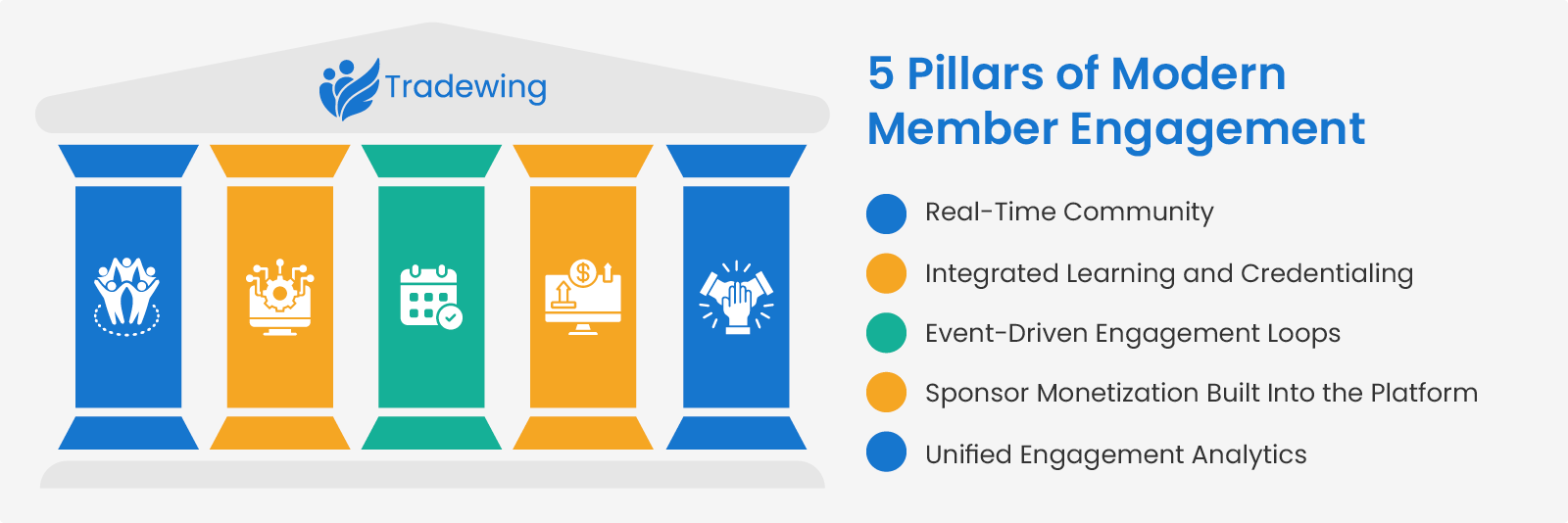
Modern member engagement is built on five interconnected pillars that transform fragmented tools into a unified ecosystem designed for participation, retention, and measurable growth.
The value of each pillar increases when they are not treated as separate systems, but as connected layers within a unified engagement infrastructure.
Modern associations don’t rely on outdated communication tools to keep members active and connected. Here are some of the changes you can implement in your association to engage your community better:
The interactions these changes will foster can reduce staff burden while building a knowledge hub that keeps members coming back. Moving beyond basic email lists to a true community platform replaces passive information sharing with a genuine sense of belonging.
Professional development has mostly relied on Learning Management Systems (LMS) that feel completely disconnected from the daily member experience. Below are ways you can integrate learning directly into your engagement ecosystem:
Merging education with community drives higher completion rates and steadier certification revenue by letting members learn and discuss content together.
Annual conferences are great for driving short-term excitement, but that momentum is often gone once attendees head home. A sustainable, long-term strategy treats the annual event not as an isolated activity, but as a main component of a year-long engagement loop. You can think of this engagement strategy in three phases:
Intentionally connecting pre-, during-, and post-event interactions ensures continuity in member participation.
Sponsors require more than just basic logo placements and physical banners that offer zero trackable data. Today, monetization means putting your sponsors right where your members are already hanging out online. In an engagement infrastructure, sponsorship is embedded directly into member activity across community, events, and learning environments. It allows sponsors to participate throughout the member journey instead of appearing only during annual conferences. Here are some ways you can increase sponsor visibility:
Embedding trackable sponsor visibility into daily member interactions and using real data to back up your prices boosts your non-dues revenue without burying your team in extra work.
Associations should be able to understand their members’ activities to engage and manage them effectively, so guesswork and intuition won’t cut it. Modern associations use engagement analytics to gain a comprehensive view of how members interact across the entire ecosystem. Some of the data that engagement analytics provide include:
By centralizing these insights, associations can easily predict retention risks, segment renewal campaigns, and optimize programming to bridge engagement gaps.
Choosing your association’s tech should not mean using complex tools you do not actually need. This quick breakdown compares Legacy AMS and enterprise add-ons to unified engagement infrastructure across the features that matter most. See why a simpler, community-first approach helps mid-sized associations drive real engagement.
|
Capability |
Legacy AMS | Enterprise Community Add-On |
Unified Engagement Infrastructure |
| Record management |
✅ |
❌ |
✅ |
| Peer networking |
❌ |
Partial |
✅ |
| Integrated LMS |
❌ |
❌ |
✅ |
| Event engagement loops |
❌ |
Partial |
✅ |
| Sponsor monetization tracking |
❌ |
❌ |
✅ |
| Unified analytics |
Limited |
Limited |
✅ |
| Built for small-to-mid associations |
❌ |
Often enterprise-focused |
✅ |
Some enterprise platforms prioritize complexity and scale over usability, creating obstacles for associations that need agility and adoption. Large, enterprise‑heavy systems often demand extensive customization, long implementation cycles, and high overhead costs. These are challenges that mid‑market associations cannot afford.
In contrast, modern member engagement is built for small‑to‑mid‑sized associations that require:
The result is a platform that empowers associations to focus on participation, retention, and non‑dues revenue growth rather than wrestling with isolated tools or enterprise systems designed primarily for scale rather than functionality.
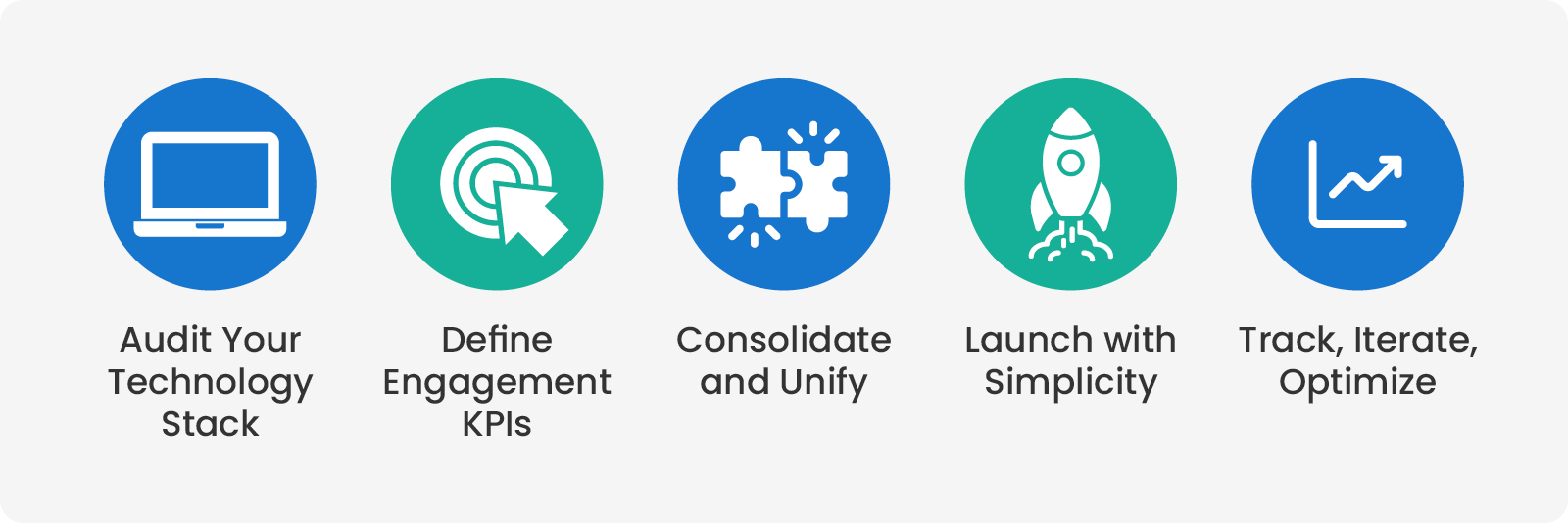
Now that you know the advantages of a unified engagement infrastructure, let’s take a look at how exactly you can transition to this model of engagement to increase retention and revenue for your association.
Every transition to modern engagement infrastructure begins with understanding how fragmented systems are currently shaping your members’ experience. Here are some steps you can take to know exactly what should be fixed:
Instead of tracking activity volume like total page views, focus on behavioral outcomes that tie directly to your association’s success. Here are some metrics you can check:
With a wide range of member engagement platforms available, you should know how to pick the best one for your organization’s needs. Here are some features core capabilities you want to look for when weighing your options:
Platforms like Tradewing are designed to reduce digital complexity by bringing community, events, and engagement workflows into a unified system that is intuitive and accessible for non-technical teams at small to mid-sized associations.
Step 4: Create Early Participation
When it’s time to go live, resist the urge to get everything moving simultaneously. Launching an engagement infrastructure is less about a single rollout and more about sequencing adoption across member groups. To avoid overwhelming your team, you can implement the common implementation approaches:
To keep your platform thriving, your team needs clear dashboard metrics to review each month so you can adjust your strategy in real time. Engagement is not static, it evolves based on how members actually engage over time.Your dashboard should monitor the following:
Following this roadmap allows associations to unlock the full potential of modern member engagement — driving retention, expanding non‑dues revenue, and building year‑round participation loops that fuel sustainable growth.
Associations looking to boost retention have to choose between layering separate tools onto legacy systems and switching to a modern member engagement that unifies community, learning, events, sponsors, and analytics into one connected ecosystem.
That’s exactly what Tradewing was built for. It cuts out the complexity, so lean teams can launch fast, boost member adoption, and see real, measurable results. Giving your members a true space to connect isn’t just an option anymore; it’s the secret to keeping your association growing.
For decades, association technology was designed around managing membership.
The next generation will be designed around sustaining participation.
Organizations that thrive won’t simply replace one software platform with another. They’ll build an engagement infrastructure that allows learning, events, community, volunteering, sponsorship, and membership to reinforce one another throughout the member journey.
That’s the shift from managing members to continuously engaging them.
Tradewing was built around that philosophy, bringing community, learning, events, and engagement together in a unified infrastructure designed specifically for small and growing associations.

Lomesh Shah is the CEO of Tradewing, leveraging over 20 years of experience in the mission-driven software space to help associations build stronger, more connected communities.

The association conference isn’t going anywhere. But today’s members increasingly expect ways…
September 4, 2026
Over the past month, we had the opportunity to join association leaders…
September 3, 2026
For decades, associations measured success through membership growth, annual conference attendance, and…
June 25, 2026