Member Engagement: 10 Creative Ideas to Excite Your Community
Boost member engagement in your Tradewing community with 10 actionable strategies, from…
October 6, 2026
If you are running an organization, you know that you need to keep your members engaged to have them stay for the long haul. As expectations for stronger digital connections rise, traditional engagement methods are quickly falling behind.
In this guide, we will cover the basics of modern member engagement and walk you through ways to upgrade your engagement strategy to build a vibrant community.
Here is a breakdown of what we will discuss:
Without further ado, let’s dive right in!

Modern member engagement is a unified, measurable, year-round digital infrastructure that powers participation, professional learning, peer networking, and non-dues revenue growth across an association’s ecosystem.
In addition to the functions of a legacy AMS, such as managing the membership database, renewals, and payments, community engagement gives associations another way to deliver value between renewals by creating opportunities for members to connect, learn, share expertise, and participate throughout the year.
Tradewing, with its unified engagement infrastructure, consolidates community, learning, events, and knowledge sharing into a single platform, helping create value for all members.
Modern engagement is:
Membership growth has become more challenging for many associations. Marketing General Incorporated’s 2026 Membership Marketing Benchmarking Report, based on responses from nearly 500 association professionals, found that 38% of associations reported membership growth. The findings point to a more challenging environment for membership growth and renewed pressure on associations to retain members and clearly demonstrate member value.
By adopting a modern member engagement platform like Tradewing, associations can bring community, learning, events, and engagement workflows into a more connected infrastructure built for small-to-mid-sized associations.
Small-to-mid-sized associations may rely on multiple systems to manage different parts of the member experience, including:
This creates what we call Engagement Fragmentation, a structural barrier to growth, and it can result in the following consequences:

When you use separate platforms for different functions, such as dues, courses, participation rates, and announcements, it becomes difficult to cross-reference information to find meaningful correlations.
For example, you cannot easily see if members who earn certifications are more likely to attend annual events, or if active forum participants renew at higher rates. This makes it harder to see the big picture and make informed decisions about engagement strategies.
How Engagement Infrastructure fixes this problem: By bringing engagement data together, associations can compare participation patterns across activities—for example, whether members who complete courses also participate in events or whether highly active community members renew at different rates from less active members. These patterns can help leadership investigate where engagement may be associated with stronger member outcomes.

Administrative work can bog down associations with lean teams. Instead of working on membership and renewal efforts, engagement initiatives, and related activities, your team may spend significant time downloading and uploading CSV reports, reconciling records between the AMS and LMS, and performing other manual administrative tasks. For lean association teams, this manual work can consume time that could otherwise be spent on member outreach, programming, community building, and other strategic priorities.
How Engagement Infrastructure fixes this problem: Engagement infrastructure can introduce automation and synchronization between systems. Integrations and APIs (Application Programming Interfaces) can allow systems to exchange data automatically, reducing duplicate data entry and some of the manual reconciliation required between separate platforms.

Digital friction can make it harder for members to participate across an association’s online experiences. ASAE’s Association Insights Center has identified building and sustaining community as a strategic priority for associations, with its guidance emphasizing accessible participation and community experiences that connect members across organizational touchpoints.
For associations managing community, learning, events, and membership across separate systems, reducing unnecessary logins and transitions can make those experiences easier for members to access and navigate.
How Engagement Infrastructure fixes this problem: Unified engagement infrastructure can use Single Sign-On (SSO) and a more cohesive user experience so members can move more easily from taking a course to discussing it in a community forum or registering for an upcoming event. Reducing these points of friction gives members a simpler path from one association experience to the next.
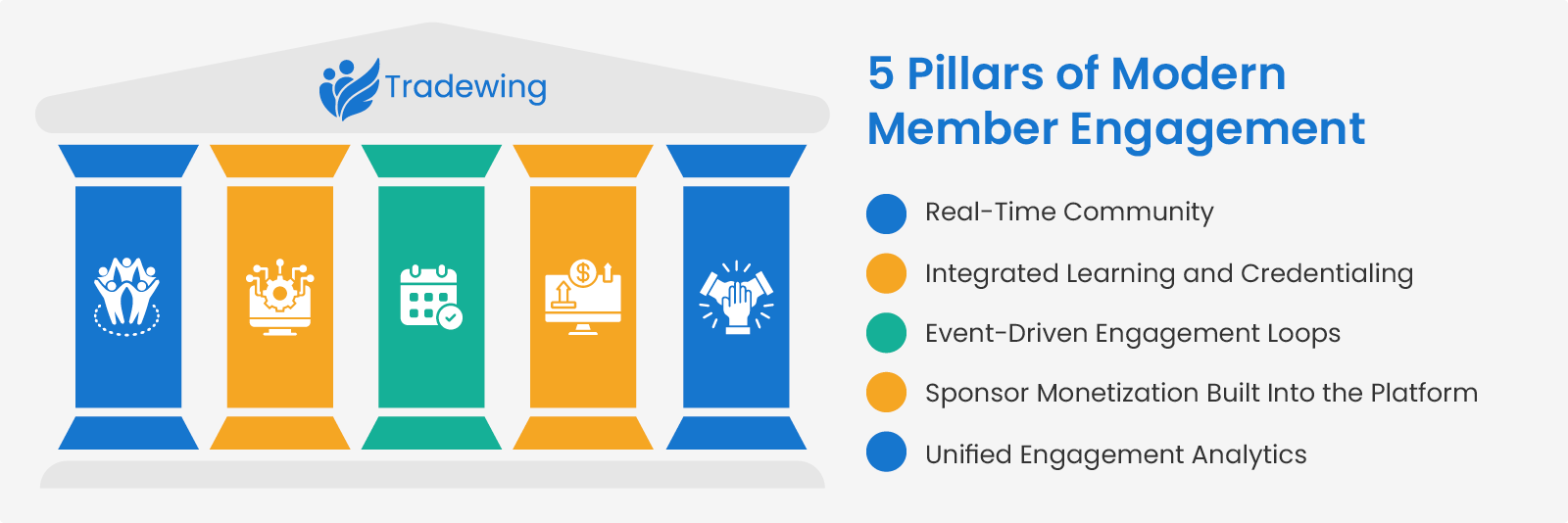
Modern member engagement is built on five interconnected pillars that transform fragmented tools into a unified ecosystem designed for participation, retention, and measurable growth.
The value of each pillar increases when they are not treated as separate systems, but as connected layers within a unified engagement infrastructure.
Modern associations don’t rely on outdated communication tools to keep members active and connected. Here are some of the changes you can implement in your association to engage your community better:
Together, these approaches can create a more organized knowledge hub where members can find conversations, resources, and peers relevant to their interests. Moving beyond basic email lists also gives associations more ways to support ongoing member-to-member interaction.
Professional development is often delivered through Learning Management Systems (LMS) that operate separately from other parts of the member experience. Below are ways you can integrate learning more directly into your engagement ecosystem:
Connecting education with community gives members opportunities to discuss what they are learning, ask questions, share practical applications, and continue interacting with course content beyond the learning module itself.
Annual conferences can generate concentrated periods of member activity and interaction. A year-round engagement strategy extends those opportunities before and after the event rather than treating the conference as an isolated activity. You can think of this engagement strategy in three phases:
Connecting pre-, during-, and post-event experiences gives members more opportunities to continue participating beyond the event itself.
Association sponsorship can extend beyond logo placements and physical banners. In an engagement infrastructure, associations can create sponsor opportunities across community, events, learning, and other member experiences, giving partners more opportunities to contribute throughout the member journey. Here are some ways you can increase sponsor visibility:
Embedding measurable sponsor opportunities across member experiences can give associations more ways to build year-round sponsorship packages and demonstrate the visibility those partnerships receive.
Associations need visibility into how members participate across their programs and experiences. Engagement analytics can help teams examine activity across community, learning, events, and other member touchpoints. Useful measures can include:
By centralizing these insights, associations can identify members with declining participation, build more informed audience segments, and use engagement patterns to guide renewal outreach and programming decisions.
Choosing your association’s tech should not mean using complex tools you do not actually need. This quick breakdown compares Legacy AMS and enterprise add-ons to unified engagement infrastructure across the features that matter most. See why a simpler, community-first approach helps mid-sized associations drive real engagement.
|
Capability |
Legacy AMS | Enterprise Community Add-On |
Unified Engagement Infrastructure |
| Record management |
✅ |
❌ |
✅ |
| Peer networking |
❌ |
Partial |
✅ |
| Integrated LMS |
❌ |
❌ |
✅ |
| Event engagement loops |
❌ |
Partial |
✅ |
| Sponsor monetization tracking |
❌ |
❌ |
✅ |
| Unified analytics |
Limited |
Limited |
✅ |
| Built for small-to-mid associations |
❌ |
Often enterprise-focused |
✅ |
Enterprise platforms are often designed to support broad requirements, extensive configuration, and complex organizational environments. Small-to-mid-sized associations may instead prioritize a narrower set of requirements: connected member experiences, lower administrative complexity, straightforward implementation, and technology that lean teams can manage effectively.
In contrast, modern member engagement is built for small-to-mid-sized associations that require:
The goal is to give associations an infrastructure that supports participation, retention, and non-dues revenue growth without requiring members and staff to navigate a collection of disconnected experiences.
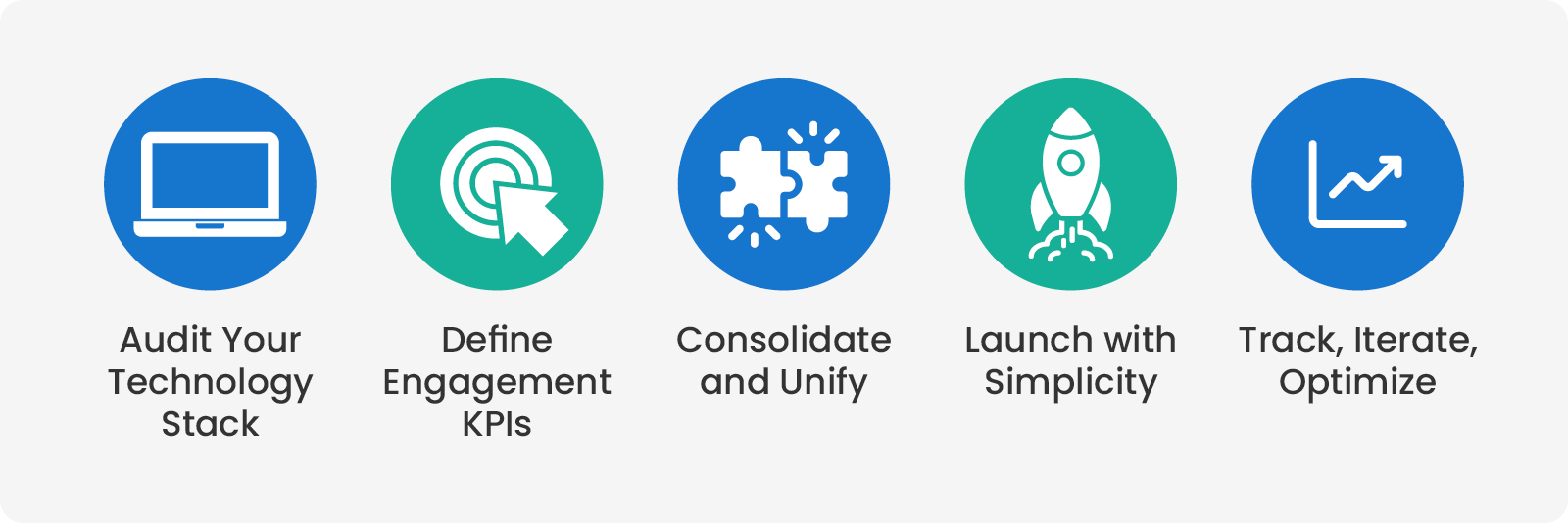
Now that you understand the advantages of a unified engagement infrastructure, let’s look at how you can transition toward a more connected model of member engagement.
Every transition to modern engagement infrastructure begins with understanding how fragmented systems are currently shaping your members’ experience. Here are some steps you can take to identify what should be improved:
Instead of relying only on activity volume such as total page views, identify behaviors that provide a clearer picture of how members participate throughout their journey. Metrics can include:
With a wide range of member engagement platforms available, evaluate the capabilities that matter most for your organization and member experience:
Platforms like Tradewing are designed to reduce digital complexity by bringing community, events, learning, and engagement workflows into a unified system that is accessible for lean teams at small-to-mid-sized associations.
When it’s time to go live, resist the urge to get everything moving simultaneously. Launching an engagement infrastructure is less about a single rollout and more about sequencing adoption across member groups. To avoid overwhelming your team, consider these implementation approaches:
Member engagement changes over time, so associations should regularly review participation data and use what they learn to adjust programming, communication, and member experiences. Useful dashboard measures can include:
Following this roadmap can help associations build a more connected approach to modern member engagement—one designed to support year-round participation, stronger member experiences, and more informed decisions about retention and revenue opportunities.
Associations evaluating their technology infrastructure can continue layering separate tools onto existing systems or move toward a more connected model that brings community, learning, events, sponsorship, and engagement data into a unified member experience.
Tradewing is built around the second approach: reducing unnecessary complexity for lean association teams while creating a more connected environment for member participation.
For decades, association technology was designed around managing membership.
The next generation will be designed around sustaining participation.
Organizations that thrive won’t simply replace one software platform with another. They’ll build an engagement infrastructure that allows learning, events, community, volunteering, sponsorship, and membership to reinforce one another throughout the member journey.
That’s the shift from managing members to continuously engaging them.
Tradewing was built around that philosophy, bringing community, learning, events, and engagement together in a unified infrastructure designed specifically for small and growing associations.

Lomesh Shah is the CEO of Tradewing, leveraging over 20 years of experience in the mission-driven software space to help associations build stronger, more connected communities.

Boost member engagement in your Tradewing community with 10 actionable strategies, from…
October 6, 2026
Looking for a platform to power your online community and sell courses?…
October 5, 2026
Community management software arms your association with the tools it needs to…
October 2, 2026