Best Practices for Smooth Association Member Onboarding
Streamlining association member onboarding enables early engagement, reinforces membership value, and lays…
October 1, 2026
Tradewing and Circle both give organizations a place to build communities, share content, host events, and create learning experiences. But they were built with different organizations and different engagement models in mind.
Circle is a broad community platform designed for creators, businesses, and membership-based communities. Tradewing is built specifically for associations, connecting the community with professional learning, Events, member data, sponsorship opportunities, and Engagement Intelligence.
For associations comparing the two, the question isn’t simply which platform has more features, but which one fits the way your organization engages members, delivers professional value, and operates year-round.
Below, we’ll compare Tradewing and Circle across the capabilities that matter most to associations.

| Features | Tradewing | Circle |
| Community | Member communities, micro-communities and private 1-on-1 messaging, and networking | Offers a forum-like space and private 1-on-1 messaging, and member profiles |
| Learning | Continuing Education Certification Program through an integrated LMS ecosystem | Has a built-in LMS (but no CE certification) |
| Events | In-person, virtual, and hybrid event experiences connected to year-round engagement | Live events and community-based event experiences |
| Engagement Analytics | Engagement Intelligence across community, learning, and events | Community and business analytics |
| Association Integrations | Designed to connect with AMS and association technology | Integrates with external business and creator tools |
| Monetization Models | Supports corporate sponsorships, sponsored content, learning, and other non-dues revenue models | Memberships, subscriptions, courses, and other creator-led monetization |
| Primary Audience | Trade associations, professional associations, and membership organizations | Creators, brands, businesses, and communities |
Both Tradewing and Circle share several fundamental capabilities that help you build an online community. They have the same core engagement mechanics, including organized discussion spaces and direct messaging. Both platforms also allow users to upload logos, apply brand colors, and use a custom domain to maintain brand consistency. Tradewing and Circle both offer mobile apps for Android and iOS, ensuring members can stay connected anytime, anywhere.
The difference becomes clearer when you look beyond community features.
Circle combines community, courses, events, and monetization for a broad range of creators and businesses. Tradewing is designed around the specific engagement model of associations, where community participation often needs to connect with professional development, Events, member data, sponsorships, and other association programs.
Learning is one example. Circle provides built-in course functionality, while Tradewing supports association-focused professional development through integrated learning and Continuing Education Certification Programs.
The same distinction applies to Events. Rather than treating an event as a separate experience, Tradewing connects event participation with the broader member community so associations can build engagement before an event and continue conversations, networking, and knowledge sharing afterward.
For associations, the key difference is therefore not simply the number of features available. It’s how those capabilities work together across the member experience.
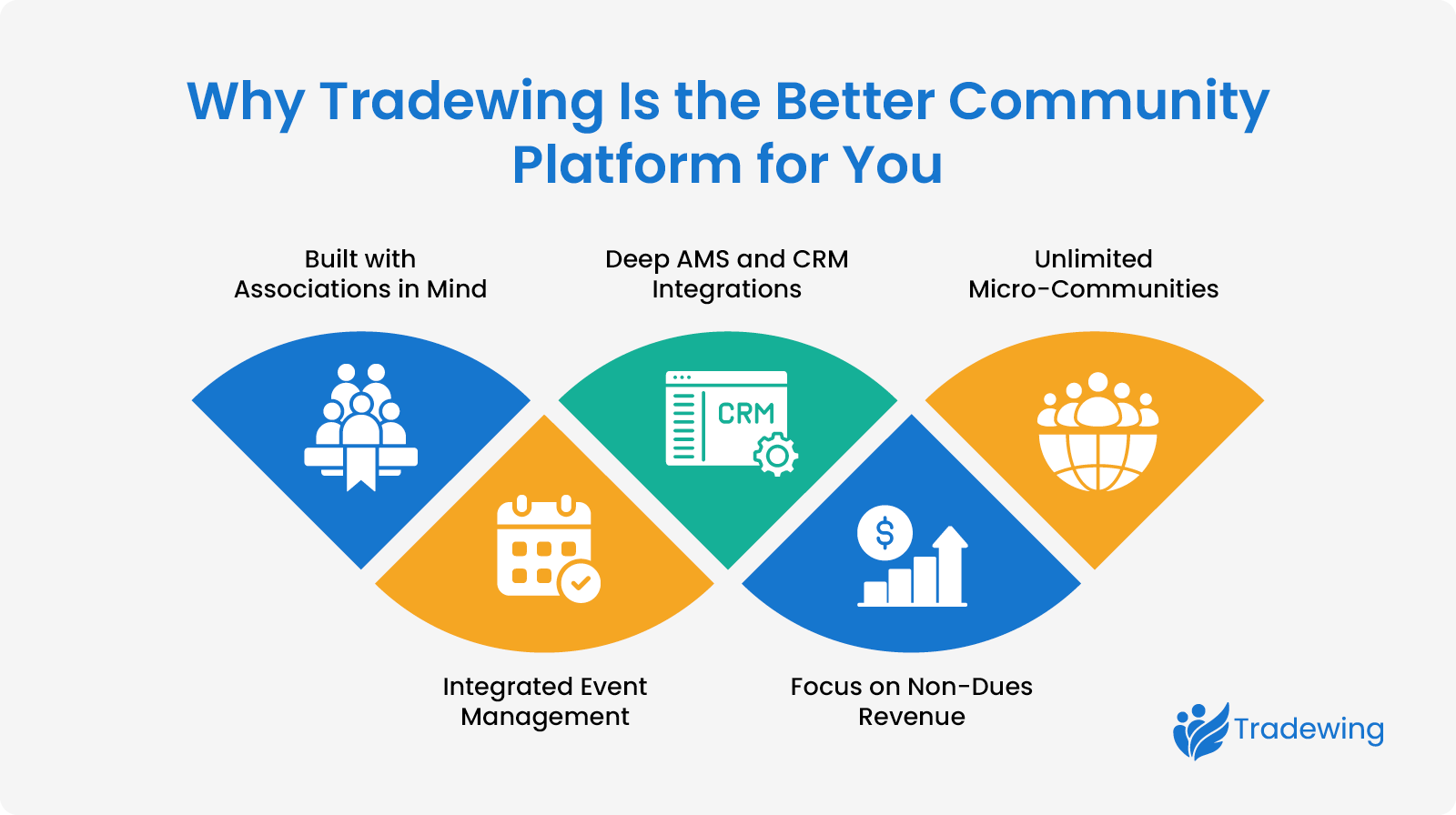
Tradewing was explicitly designed for associations and membership organizations. Our platform provides member management tools, such as a structured member directory with detailed profiles, flexible membership models, and lifecycle automation.
Associations also get deeper visibility into member insights with Tradewing’s Engagement Intelligence. You can monitor activity across communities, learning programs, and events, allowing you to spot behavioral patterns and act accordingly. For example, if you see that a member hasn’t logged into your platform in the last three months, you can intervene with a re-engagement campaign instead of waiting for them to lapse.
For many associations, events are the most important moments in the member journey. from massive conferences to smaller to more intimate gatherings. Tradewing connects those moments to the broader engagement experience rather than treating them as standalone activities.
In addition to the standard event registration functionality, our platform can host events in any format, whether they’re in-person, virtual, or a mix of both, and enable real-time interactions. This paves the way for stronger community-building and collaboration. It’s also easy to build momentum before the event and sustain engagement afterward thanks to its integrated community forums.
Circle also supports live events and community-based experiences. The distinction for associations is how Tradewing connects event participation with other association engagement touchpoints, including community, learning, and member data.

Associations typically rely on an AMS or CRM as their primary system of record. Adding a separate community platform can therefore introduce another integration that staff need to configure and maintain.
Circle offers APIs and integrations that can connect its community platform with external systems. However, because Circle serves a broad range of creators, businesses, and communities, connecting it with association-specific systems such as an AMS may require additional integration or automation tools to keep member data and access aligned.
Tradewing, on the other hand, is designed to integrate with your various association tools, especially your association management software (AMS). This way, when a member renews, updates their profile, or lapses in your main database, that data syncs across your entire tech stack. This helps reduce fragmented workflows while giving staff a more connected view of membership and engagement.
Revenue diversification is another area where the platforms reflect their different audiences.
Circle provides monetization tools for selling memberships, subscriptions, courses, and other paid community experiences. Tradewing approaches monetization through the association model, where revenue can come from professional learning, premium resources, events, and sponsor relationships. In particular, you can sell premium gated resources, such as industry reports, or offer sought-after CE programs for professionals who want to improve their skills
Tradewing also supports corporate sponsorships by allowing you to integrate sponsors into the digital member experience and partner-created content on your community platform.
Rather than limiting sponsorship visibility to an annual conference or logo placement, associations should create opportunities for sponsors to provide value and engage members throughout the year.
Both Tradewing and Circle allow organizations to create focused spaces for different audiences and interests. Tradewing’s unlimited micro-communities give associations flexibility to organize engagement around chapters, committees, professional interests, career stages, or other member segments.
Your association can create unlimited micro-communities for specific niches and interests. For instance, an engineering association could form a dedicated group for young professionals interested in renewable energy while maintaining separate spaces for committees, regional chapters, or technical specialties.
Circle is a strong option for creators, businesses, and organizations primarily looking to build and monetize an online community.
Tradewing is built for associations whose member experience extends beyond community alone. It connects community, Continuing Education Certification Programs, Events, sponsorship opportunities, member data, and Engagement Intelligence within a broader engagement infrastructure for modern associations. That distinction matters because association engagement rarely happens in one place. Members may attend an event, complete professional development, join a discussion, connect with a peer, or interact with a sponsor at different points throughout the year. Tradewing is designed to connect those experiences rather than treat them as separate activities.
For associations evaluating Circle and Tradewing, the decision ultimately comes down to what you need your platform to do: host a community, or help connect the experiences that drive year-round member engagement.
If you’re evaluating how community fits into your broader member experience, see how Tradewing connects community, learning, Events, member data, and Engagement Intelligence in one Engagement Infrastructure.


Petreysha is a Business Development Associate at Tradewing, partnering with associations to strengthen member engagement, build connected communities, and modernize the member experience through technology that supports long-term growth.

Streamlining association member onboarding enables early engagement, reinforces membership value, and lays…
October 1, 2026
For lean association teams, dues collection can create more administrative work than…
September 21, 2026
Did you know that many professional organizations experience a severe drop-off in…
September 8, 2026