Best Practices for Smooth Association Member Onboarding
Streamlining association member onboarding enables early engagement, reinforces membership value, and lays…
October 1, 2026
Imagine this: you’ve announced your upcoming conference on recent trends and challenges in your sector. You’ve invited renowned industry experts to speak at the conference and prepared hands-on workshops that engage attendees. Your tickets have sold out—the revenue is greater than last year’s—and on the day of the event, it’s a full house. It’s looking to be a success! Until the event concludes, and all of a sudden, member engagement on your digital platforms drops off.
Member engagement declining after an event is a common issue that associations face, and the culprit is often a lack of a strategic follow-up infrastructure. Every session attended, discussion started, question asked, and connection made during an event creates valuable engagement signals. Without a system to capture and extend those interactions, much of that momentum is lost. Fortunately, you can take steps to address this problem and extend your member engagement year-round.
In this guide, we’ll explore the necessity of building a robust engagement infrastructure after hosting an association event and step-by-step strategies to turn event attendees into active, daily participants in your community.
Events are undoubtedly crucial for associations, but many treat them as standalone milestones. As a result, they fail to capitalize on the momentum generated during their conferences and trade shows because they simply don’t follow up with their members afterward. Many associations don’t have a structured way to continue those interactions once the event ends. This abrupt silence following an event results in issues that may stunt your organizational growth, such as:
Instead of viewing events as the finish line, think of them as a starting point for your association’s engagement strategy. To retain members, you must provide ongoing value throughout the year, and your conferences, trade shows, and even micro-events are a great source of inspiration for that. With these events, you can come up with various ways to interact with your community—from offering educational programming to volunteering opportunities and more.
When associations connect those engagement moments together, they begin building an engagement infrastructure instead of running isolated events.
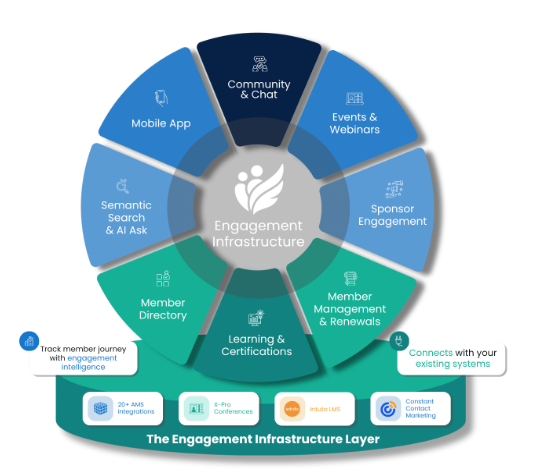
The solution to the lack of post-event engagement is simple: your association must focus on building an engagement infrastructure, which is the connected system of experiences, processes, and technology that enables members to continuously learn, connect, participate, and contribute throughout the year. The primary goal of an engagement infrastructure is to support continuous interaction and collaboration all year long.
When it comes to events in particular, an engagement infrastructure moves beyond just registration and logistics. Instead, it transforms events into an ongoing experience by enabling you to:
That said, one thing to keep in mind about engagement infrastructure is that it’s not meant to replace traditional operational systems like association management software, but rather, it’s intended to work alongside them. Your AMS manages operational data like membership records, renewals, and billing. Engagement infrastructure builds on that foundation by helping members connect, learn, collaborate, and participate continuously between administrative interactions.
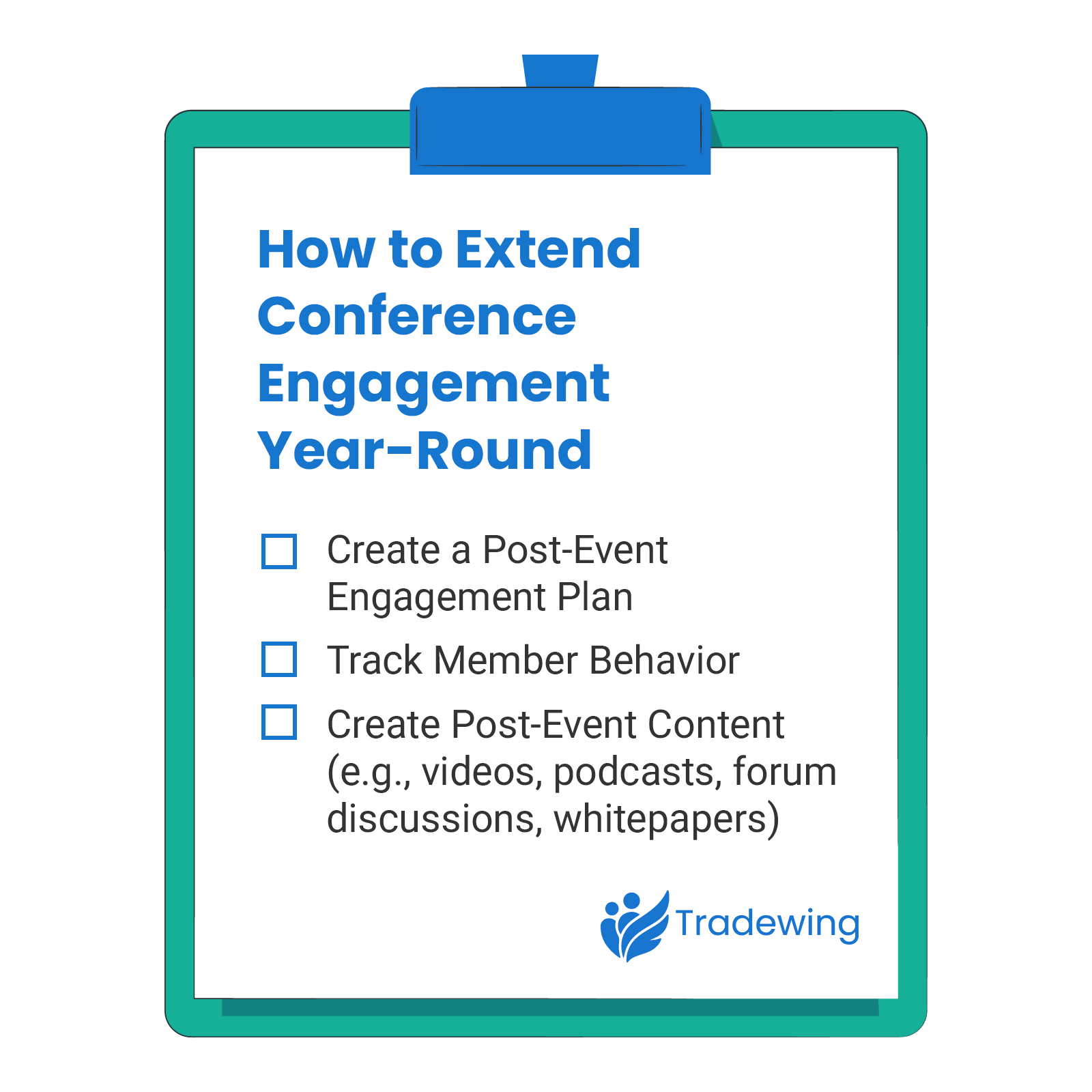
Year-round engagement must be meticulously built into the initial planning phase, not scrambled together in a panic after the event. If you wait until the venue is empty to figure out your next steps, you have already lost your audience’s attention.
As you draft your post-event plan, define with your team exactly what you want to keep going after the event ends. Are you driving ongoing education, building a peer-to-peer community, or increasing sponsor visibility for your partners?
Once you’ve narrowed down your focus, you can start brainstorming strategies (e.g., repurposing live talks into webinars and starting specific discussion threads) and building your post-event engagement calendar.
Attendance only tells you the number of people who showed up to the event. To know exactly what to discuss with your members for the rest of the year, you need to review the deep behavioral data. To do this, you can:
This behavioral data isn’t just helpful for brainstorming year-round content; you can also use it to segment your email lists. By grouping members who are interested in the same topic, you can send a tailored follow-up campaign that will capture their attention.
Now that you have your goals and your behavioral data, it’s time to create your post-event content. Instead of dumping all event recordings onto a buried webpage where links expire after a few weeks, consider the following strategies:
When making your post-event content, prioritize variety. Live recordings are beneficial for people who weren’t able to attend the event and those who want to revisit the discussion, but if that’s all you share, members may get bored. Instead, you can try turning dense panels into articles or short highlight videos.
Another smart move is to create engaging podcasts from your most successful events. Strip the audio from your highest-rated keynotes or panel discussions to launch a dynamic post-conference podcast series. This gives members the flexibility to consume long-form educational content on the go during their commutes or daily workouts. Just keep in mind that if you plan to repurpose live talks into a podcast, you need to prepare beforehand. You’ll need a decent microphone and a recording device to ensure you’re capturing crisp audio.
Additionally, when building your event-based learning library, implement an intuitive hierarchy so your members won’t struggle to find what they need. For example, you can organize recorded sessions not by the original daily agenda, but by highly relevant topics.
A strong, resilient online community actively participates rather than just passively listening to top-down broadcasts. Leverage your online community platforms to spark vibrant conversations among your members. Some strategies you can try include:
To ensure these digital conversations maintain their momentum, consider introducing a subtle gamification strategy to reward your most vocal members. Incentives like digital badges or exclusive discounts for future conferences drive consistent daily participation.
Another piece of content you can create based on your recent event is a polished executive summary or a comprehensive whitepaper. This creates a high-value downloadable asset you can use for year-round lead generation and member acquisition (e.g., by offering it as a free gift to newsletter subscribers).
To make the most of this initiative, you can host an exclusive webinar walking through the findings of the insights report. This gives you yet another high-touch engagement opportunity and allows members to ask questions about the data in real-time.
Small associations should focus on strategies that their lean teams can implement without too much hassle. For example, sparking conversations on forums and creating short videos based on the event are fairly manageable.
Additionally, small associations should adopt a unified engagement infrastructure to centralize all member interactions on a single platform. This streamlines administrative workflows, enabling your staff to focus on developing more engagement strategies.
No. In fact, offering conference content online actually drives future event registration. Think of your digital content library as a marketing engine. When non-attendees watch an incredible recorded keynote, they may experience fear of missing out on the live networking energy and try to attend your next event.
Continuous digital engagement opens up entirely new, highly lucrative channels for non-dues revenue. You can monetize year-round participation by:
To gauge your year-round engagement strategy’s success, track daily active users (DAU) and monthly active users (MAU). If your strategy is working, you will see a steady, consistent flow of member logins and peer-to-peer messages long after the event concludes. Additionally, high retention rates and increased participation in community discussions are indicators that your members are finding ongoing value in your association.
Adopting a unified platform ensures the energy you sustained from your conference continues, even months after the event. Tradewing equips association leaders with the manual for converting members who attend events only once or twice a year into dedicated, daily participants.
Stop letting your most valuable momentum slip away the moment the closing remarks finish. Build your continuous digital ecosystem today and watch your member loyalty soar.

Rhona is a Marketing Specialist at Tradewing, creating content and campaigns that help associations strengthen member engagement, simplify communications, and support long-term growth.

Streamlining association member onboarding enables early engagement, reinforces membership value, and lays…
October 1, 2026
For lean association teams, dues collection can create more administrative work than…
September 21, 2026
Did you know that many professional organizations experience a severe drop-off in…
September 8, 2026