Choosing the Right LMS for Your Association
A member signs up for a course through your association, completes the…
November 11, 2026
The next course your association offers might begin with a question in a member discussion.
A new regulation sparks debate. Members compare how they’re interpreting the rules, trade practical advice, and raise questions that existing training materials haven’t answered. It’s the kind of conversation an education team should pay attention to.
Associations have access to something general course providers spend considerable effort trying to build: a network of people who understand the profession from the inside. That includes practitioners dealing with its daily challenges and experts who help shape its standards.
There’s an opportunity to turn that knowledge into education members find useful. The harder part is deciding which conversations warrant a formal program, what people actually need to learn, and how to deliver it without overwhelming the team responsible.
A short expert session might resolve an immediate question. A complex compliance issue could call for structured instruction, assessments, and continuing education credits. Those decisions belong in the education strategy before anyone starts comparing software.
Once the learning requirements are clear, the technology question becomes more interesting. Community platforms with learning management system (LMS) capabilities differ in how they support formal courses, professional discussions, member access, and administration. Understanding those differences matters when an association wants to build on the expertise already circulating through its membership.
Community platforms with LMS capabilities generally take two approaches: connecting a dedicated learning management system with a community environment or providing native course tools within the community platform.
Tradewing, Forj, and Higher Logic offer association-focused community solutions with dedicated LMS capabilities available through connected products or add-ons. Circle and Mighty Networks provide native course creation tools within their community environments.
Both approaches can support professional education, although the differences become more apparent when an association considers its existing technology, administrative responsibilities, and the kind of learning experience it wants to offer.
| Platform | Learning approach | Best potential fit | Key consideration |
|---|---|---|---|
| Tradewing | Optional Association Learning Communities add-on powered by Intuto LMS | Associations connecting structured education with broader member engagement | Confirm LMS add-on scope, CE workflows, and integration requirements |
| Forj | Dedicated Forj Learn LMS connected with Forj Connect | Associations managing formal learning alongside community participation | Evaluate the combined product configuration and learning data requirements |
| Higher Logic | Thrive Learn LMS add-on powered by Path LMS | Associations seeking learning capabilities within an established community ecosystem | Review licensing and integration with existing Higher Logic products |
| Circle | Native course builder | Organizations launching courses and paid educational communities | Verify formal CE, reporting, and AMS requirements |
| Mighty Networks | Native courses and progress tracking | Organizations emphasizing interactive and community-led learning | Assess learning-record reporting and association-specific administration |
This comparison is based on publicly described product capabilities and potential use cases. It is not an independently tested performance ranking. Features, integrations, and pricing may vary by subscription and implementation.
Member discussions can be a useful starting point for education planning, but a busy discussion thread is not proof that members will enroll in a course.
Member discussions can provide useful direction for education planning, particularly when the same questions arise across different groups, committees, or professional specialties. Yet a lively conversation doesn’t necessarily indicate sufficient demand for a formal course, and associations need to distinguish an interesting topic from a genuine learning requirement.
Consider a new compliance obligation that members are struggling to interpret. Their discussions may reveal uncertainty about what the regulation means, but the education team still needs to understand whether members require introductory guidance, more advanced instruction, or practical support applying the rules.
A short briefing from a subject-matter expert may resolve the immediate confusion. If the issue involves responsibilities members must demonstrate competence in, a structured course with assessments and continuing education credits may be more appropriate, provided it meets the relevant program requirements.
The financial considerations matter as well. Some programs belong within existing membership benefits, while others may justify a separate fee because they address a specialized professional need. Either way, the association should have a reasonable understanding of demand before committing staff time and resources to developing the content.
This is where the relationship between community and learning becomes particularly interesting. Member conversations can help associations recognize emerging educational needs, while formal learning provides a way to address those needs through more structured instruction.
The platform an association chooses should support the educational programs it intends to deliver, while also accounting for how learning fits into the broader membership experience.
Community and learning platforms vary considerably in how they approach education, professional networking, and member participation. Some provide dedicated learning management systems alongside association community software, while others make it possible to create and deliver courses directly within the community environment.
The distinction matters because associations are rarely evaluating course delivery in isolation. They also need to consider how educational programs fit into existing membership structures, how members discover relevant opportunities, and whether the technology supports the kinds of professional relationships their organizations are built around.
The following five platforms offer different approaches worth considering.
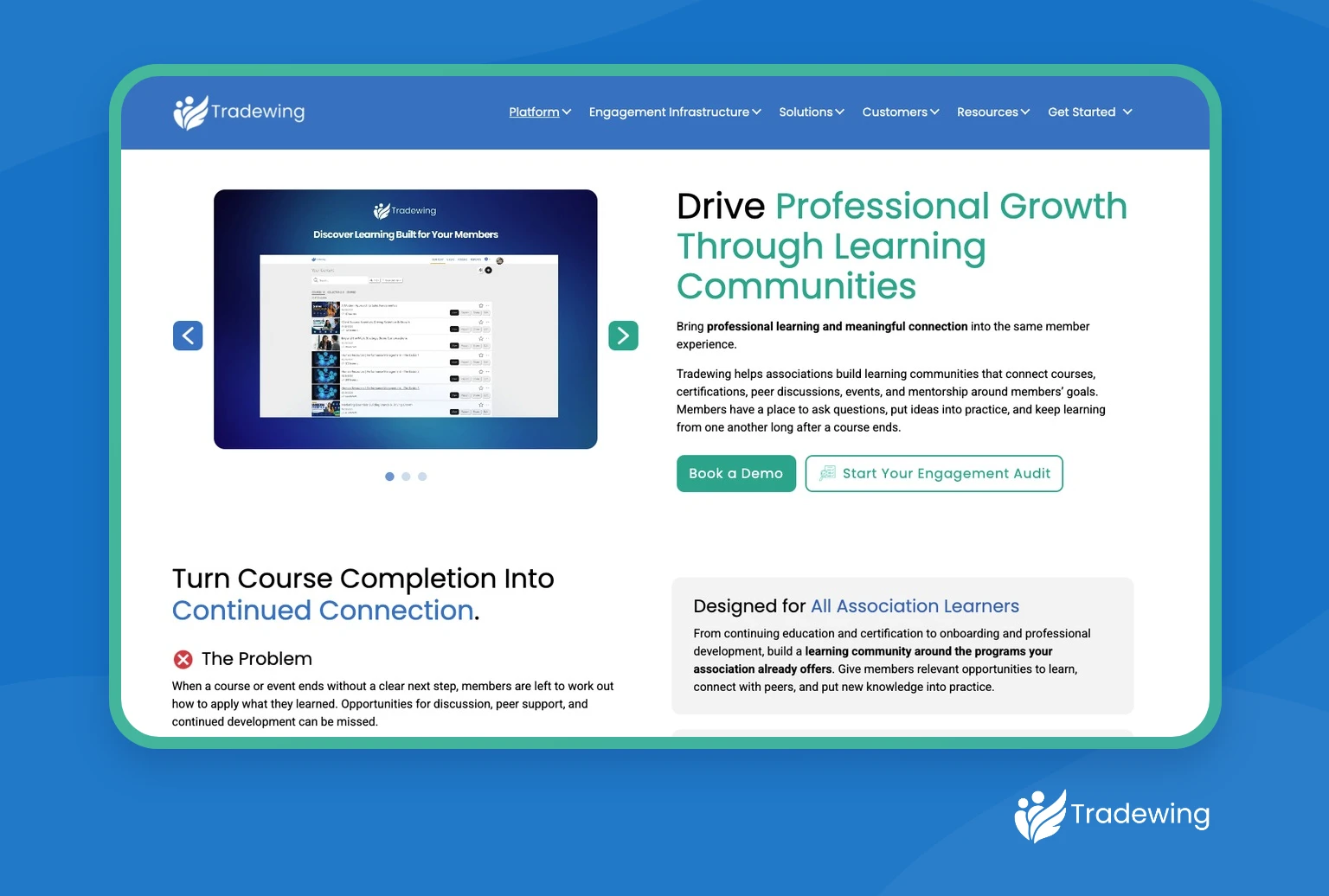
Tradewing approaches learning as part of a broader association engagement experience, connecting professional education with community discussions, networking, events, and member resources.
Through Association Learning Communities, powered by Intuto LMS, associations can offer structured courses and assessments while maintaining opportunities for members to exchange knowledge beyond formal instruction. For example, a course addressing new industry standards could be complemented by expert discussions and professional resources, allowing members to explore how the material applies to their work.
This approach reflects Tradewing’s broader focus on engagement infrastructure, where learning is one component of the member experience. Its AMS integration options also allow associations to build on existing membership systems rather than requiring a complete technology replacement.
Key capabilities
Best suited for: Associations seeking to connect formal education with ongoing member engagement, particularly those looking to complement their existing membership technology.
Association Learning Communities is an add-on, so associations should confirm supported learning workflows, reporting, integrations, and implementation requirements.
Learn more about Tradewing’s Learning & Certification capabilities.
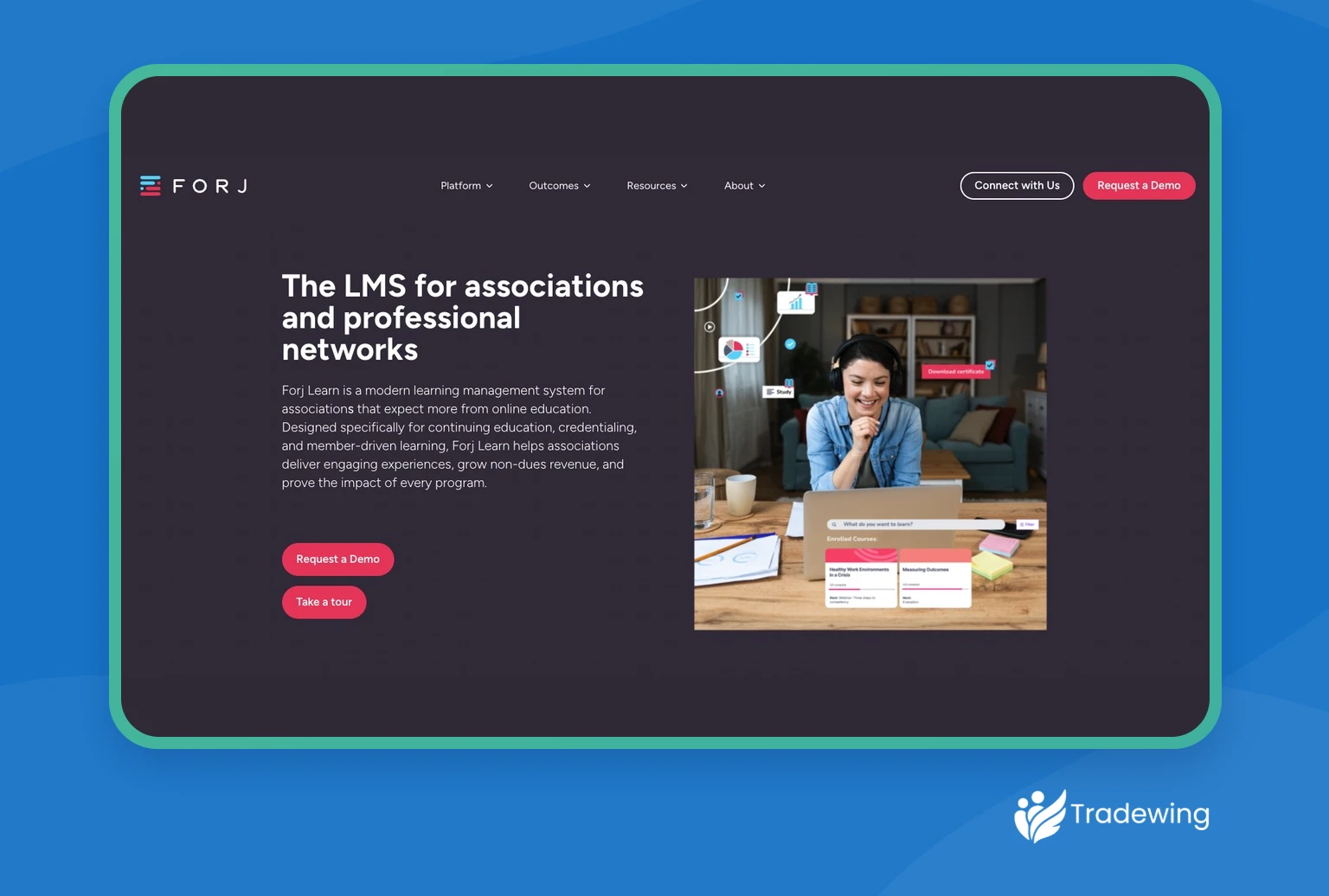
Forj provides association-focused learning and community technology designed to support professional education alongside networking and peer interaction.
Its approach combines dedicated learning management functionality with community capabilities, allowing associations to administer structured educational programs while providing spaces for members to exchange knowledge. For organizations managing substantial continuing education catalogs, this may offer a way to maintain formal learning requirements while encouraging participation beyond coursework.
Forj also emphasizes learning and engagement insights, which may appeal to associations looking to better understand how members participate across educational programs and community activities.
Key capabilities
Best suited for: Associations with established professional development programs that want dedicated learning administration alongside community engagement and participation insights.
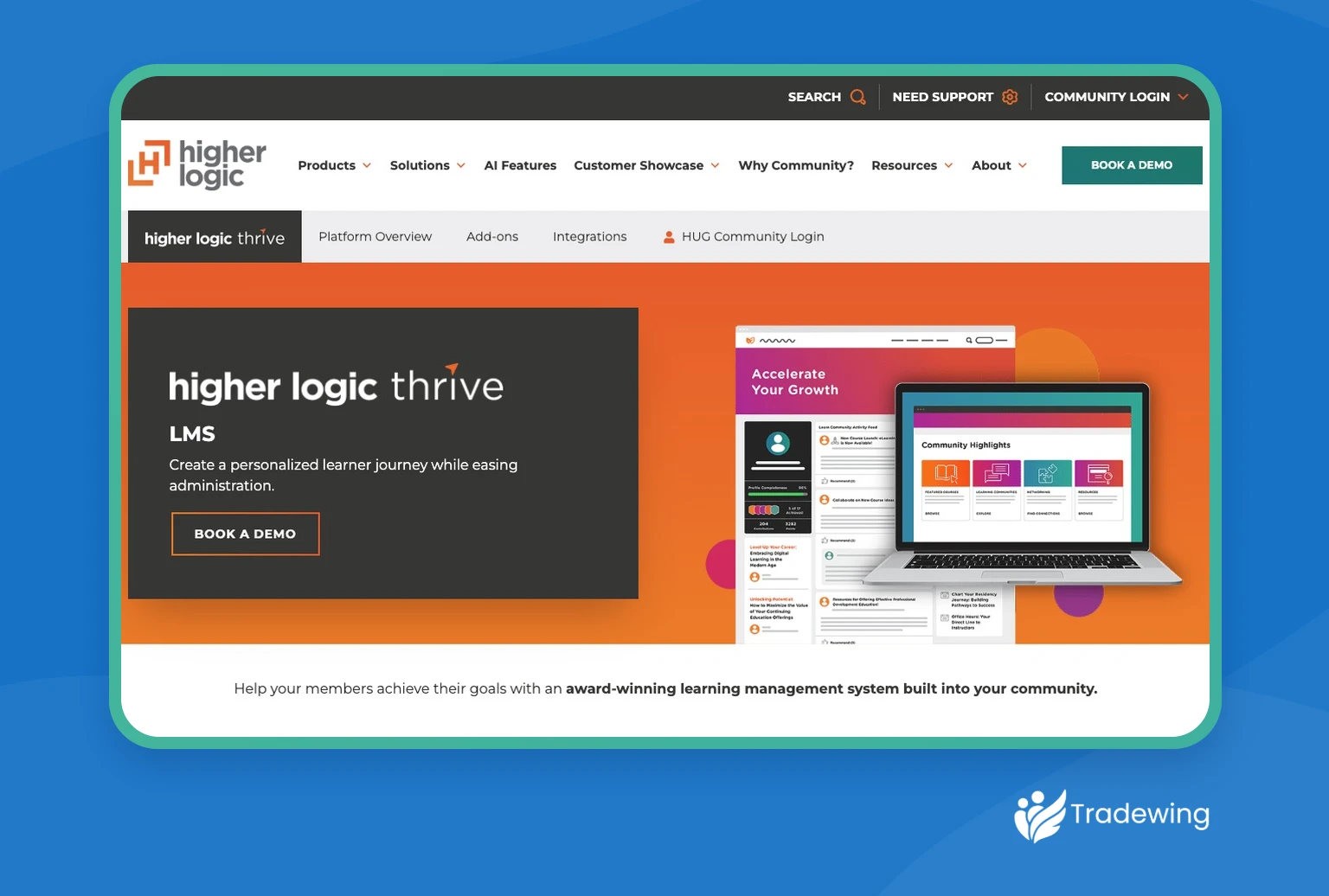
Higher Logic offers community technology for associations, with dedicated LMS capabilities available through an additional learning solution.
Its approach allows organizations to introduce structured education alongside existing community activities, including discussions, events, and member resources. Educational recommendations can also help members discover programs connected to their interests, providing another point of connection between learning and community participation.
For associations already using Higher Logic, expanding learning capabilities within the same vendor ecosystem may be worth investigating, particularly when the organization has established workflows and staff familiarity with its community platform.
Key capabilities
Best suited for: Associations already invested in Higher Logic’s community ecosystem or those seeking learning capabilities through an established association technology provider.
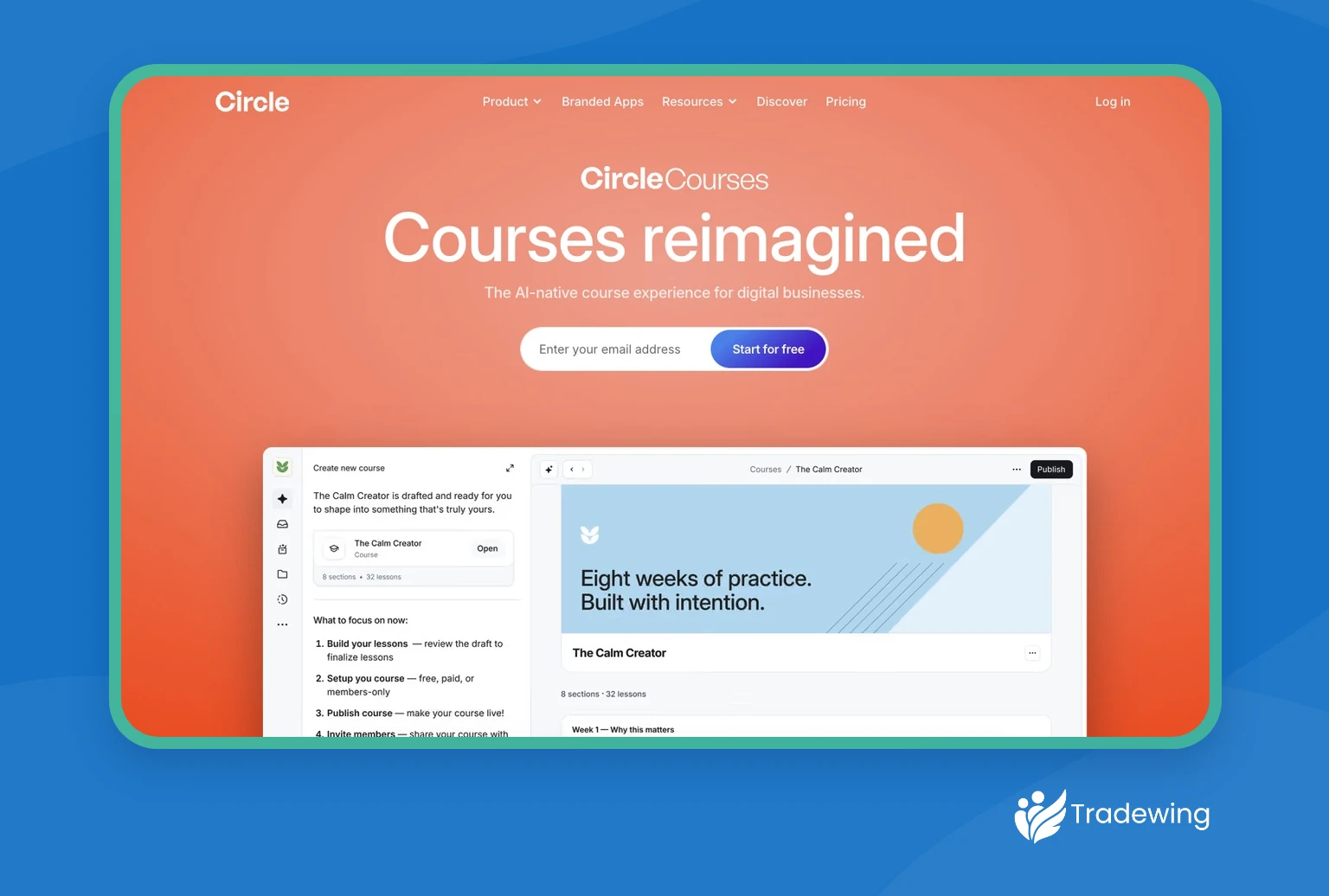
Circle combines native course creation with community discussions, live events, and paid membership experiences, making it relevant to organizations that want to offer education within an online community.
Associations launching specialist professional development programs could use Circle to organize lessons, host expert sessions, and provide discussion spaces where participants can exchange experiences related to the material. Its native course tools may be sufficient for relatively straightforward educational offerings, although organizations with formal CE or credentialing responsibilities should evaluate those requirements separately.
Key capabilities
Best suited for: Associations launching educational memberships, specialist learning communities, or online courses that do not require extensive learning administration.
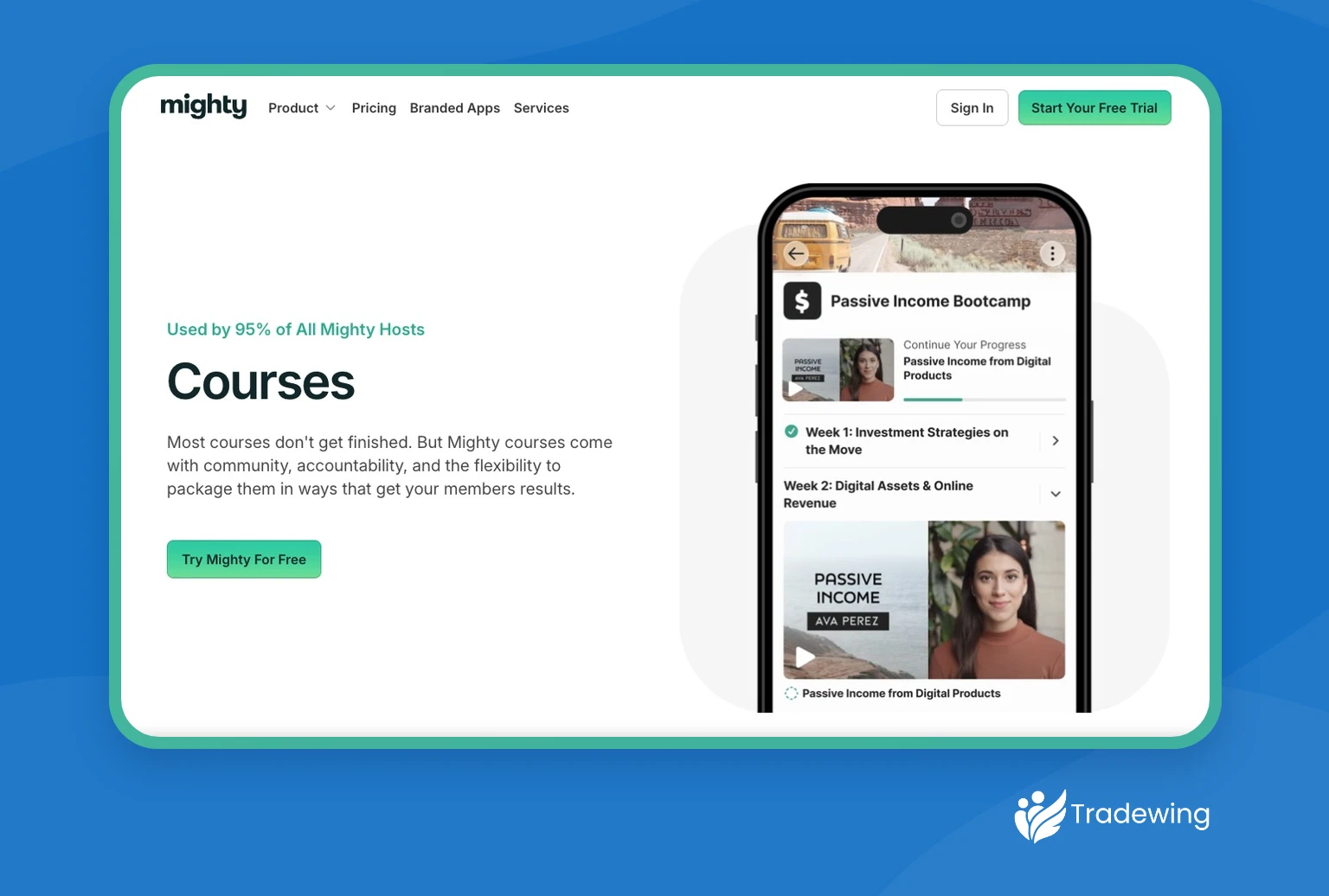
Mighty Networks offers native course tools alongside community spaces, events, and membership experiences, with an emphasis on bringing learning and participant interaction together.
Its approach may be relevant to associations developing facilitated professional development programs where discussions and peer exchange form part of the learning experience. For example, a leadership program could combine independent coursework with live sessions and opportunities for participants to share challenges encountered in their workplaces.
While these capabilities support community-oriented education, associations with formal continuing education responsibilities should confirm whether the available learning administration and reporting meet their needs.
Key capabilities
Best suited for: Associations developing facilitated learning programs, educational memberships, or topic-based communities where peer participation is central.
The most suitable platform depends on the association’s educational responsibilities, the technology it already uses, and the role community participation is expected to play.
An association administering formal continuing education programs may place greater emphasis on learning records, assessments, and reporting, while an organization launching a professional development community might prioritize facilitated discussions, course access, and the ability to coordinate live activities.
Both organizations may value the relationship between learning and community, but the software they require could look quite different.
| Your association’s situation | What to prioritize | Platforms worth evaluating |
|---|---|---|
| You manage established CE or credentialing programs | Dedicated LMS functionality, learning records, assessments, and reporting | Tradewing with Intuto, Forj, Higher Logic with Thrive Learn |
| You want education to support broader member participation | Connections between learning, discussions, events, and resources | Tradewing, Forj, Higher Logic |
| You’re launching a relatively straightforward paid course program | Native course creation, enrollment, payments, and ease of administration | Circle, Mighty Networks |
| You’re building a facilitated learning community | Peer discussion, group participation, live sessions, and coordinated learning activities | Mighty Networks, Circle, Forj |
| You already use one of these community platforms | Whether additional learning functionality fits your existing environment | Evaluate your current vendor’s learning offering first |
These are starting points for a shortlist rather than exclusive recommendations. Each platform should still be evaluated against the association’s specific requirements.
Software comparisons often begin with a list of features, but associations rarely make purchasing decisions without an existing technology environment to consider.
An organization already using Higher Logic, for example, may have practical reasons to investigate Thrive Learn before introducing another community platform. Similarly, an association with a reliable LMS may prefer to preserve that investment while exploring additional capabilities that make education more visible and accessible within its member community.
The implications extend beyond licensing costs. Staff familiarity, historical learning records, integrations, and the administrative processes already in place all influence how disruptive a change might be.
Rather than treating every platform as a fresh start, associations should consider what they can build on and where their current environment genuinely limits the experience they want to provide.
For a detailed framework covering LMS assessments, continuing education, certification, AMS integration, and vendor demonstrations, see Tradewing’s Association LMS Buyer’s Guide.

Learner engagement remains a challenge for association education providers. In The Strategic Outlook for Association Learning Businesses 2026, published by Leading Learning, 31.1% of surveyed association learning businesses identified a lack of learner engagement as one of their top challenges to maintaining or growing education enrollments.
For associations evaluating community platforms with LMS capabilities, the finding reinforces the importance of looking beyond course delivery and completion tracking. Educational programs may meet their instructional objectives while leaving opportunities for members to discuss what they’ve learned, exchange practical experiences, and continue developing professionally.
Consider a member who finishes training on a new industry regulation. The course may explain the requirements and assess understanding, but applying those requirements in the workplace can raise questions that the original instruction couldn’t anticipate.
The member might benefit from comparing interpretations with colleagues, reviewing additional resources, or participating in a follow-up discussion led by a subject-matter expert. Associations often provide these opportunities already, whether through committees, professional communities, webinars, or events. The difficulty is that members may not encounter them when they’re most relevant.
A community-connected learning approach can help bring these experiences closer together, making it easier for members to continue learning and participating after completing a course.
A member conversation about an emerging industry issue might reveal demand for a workshop, while questions raised after a course could become the basis for a peer roundtable or an updated educational resource.
These connections can also work in the other direction. Experienced practitioners may identify problems that formal training has overlooked, giving the education team insight into how existing programs could be improved.
For example, an association delivering compliance education might invite participants to discuss implementation challenges after completing the course. The discussion would give members a reason to exchange experiences, while helping the association identify questions that may require further clarification or education.
None of this requires every interaction to occur within a single application. What matters is whether members can discover relevant opportunities and whether association staff can coordinate them without creating unnecessary administrative work.
There is an important distinction between making discussions available and giving members a compelling reason to participate.
A course discussion space may remain quiet if participants have no meaningful questions to address. A facilitated exchange about a shared professional challenge, however, gives members something concrete to contribute and a reason to learn from one another.
Associations have an advantage here because their communities already bring together people working within the same profession or industry. The opportunity is to connect those relationships with education in ways that help members apply knowledge, solve problems, and continue developing professionally.
The software can support that work, but the value ultimately depends on the association’s educational design and its understanding of what members need.
An association interested in connecting education with community participation doesn’t necessarily need to replace the learning management system it already uses.
If the existing LMS reliably delivers courses, maintains learning records, and supports the organization’s educational requirements, replacing it may introduce costs and operational disruption without addressing the actual limitation.
The challenge might instead be that educational programs operate separately from the member discussions, resources, and events that could make them more useful.
In that situation, adding community capabilities may be more practical than rebuilding the learning environment. The association would still need to evaluate how members access the different systems and what integrations are required, but it could preserve learning processes that staff already manage successfully.
A more extensive platform change may be justified when the existing LMS cannot support essential educational requirements, is difficult to administer, or creates persistent problems that additional integrations are unlikely to resolve.
The distinction matters because associations should be clear about the problem they’re trying to solve before they begin replacing technology.
Tradewing, Forj, and Higher Logic offer association-oriented community platforms with dedicated LMS capabilities available through connected solutions or add-ons.
Tradewing provides Association Learning Communities, an optional add-on powered by Intuto LMS, while Forj and Higher Logic offer dedicated learning functionality alongside their community platforms. Each takes a different approach to course administration, community engagement, and system integration, so associations should evaluate how these capabilities fit their existing technology and educational requirements.
Both Circle and Mighty Networks offer native course creation tools alongside community features, making them relevant to associations developing online education programs where member participation is part of the experience.
Circle combines courses with discussions, live events, and paid membership offerings, while Mighty Networks places particular emphasis on community-led learning and interaction among participants. Associations should compare how each platform supports their intended educational format, administrative requirements, and opportunities for peer engagement.
Yes. Associations can retain an existing LMS and introduce a community platform to support professional discussions, networking, events, and other activities surrounding their educational programs.
This approach can be practical when the current LMS already meets the association’s course administration and continuing education requirements. However, organizations should consider how members will access both systems, whether relevant integrations are available, and what additional administrative work may be involved.
Native course platforms can support certain continuing education programs, particularly those with relatively straightforward course delivery and assessment requirements.
However, associations administering formal CE credits or professional certifications may need more specialized functionality for tracking completions, maintaining learning records, and producing required documentation. These requirements should be verified before selecting a platform.
Not necessarily. While bringing learning and community activities into a connected experience can make educational opportunities easier to discover and provide additional ways for members to participate, it doesn’t require every function to operate within the same software.
Some associations may benefit from a platform that combines these capabilities, while others may prefer to connect existing systems that already meet their needs. The better choice depends on the association’s learning strategy, available integrations, and the experience it wants to provide members.
The five platforms in this comparison offer different approaches to connecting structured education with professional community participation. Choosing among them requires associations to consider not only their learning programs but also how members discover educational opportunities, exchange knowledge, and continue developing professionally.
For associations managing formal continuing education, dedicated LMS capabilities may be a priority, making Tradewing, Forj, and Higher Logic relevant options to investigate. Organizations developing educational memberships or community-led learning programs may also find Circle and Mighty Networks worth considering, depending on their administrative requirements.
Ultimately, the strongest choice is the one that supports the association’s educational strategy while building on the technology and member relationships it already has. Rather than focusing solely on feature comparisons, associations should ask shortlisted vendors to demonstrate how their platforms would support the learning experiences they intend to deliver.
An association’s educational programs should reflect the knowledge its members need, the standards its profession maintains, and the opportunities available for continued professional development.
Tradewing’s Association Learning Communities, an optional add-on powered by Intuto LMS, brings structured education into a broader member experience that includes professional discussions, events, networking, and resources.
Explore Tradewing’s Learning & Certification capabilities to see how this approach could support your association’s professional development programs.

Rhona is a Marketing Specialist at Tradewing, creating content and campaigns that help associations strengthen member engagement, simplify communications, and support long-term growth.

A member signs up for a course through your association, completes the…
November 11, 2026
When an association begins looking for member engagement software, the frustrations behind…
October 30, 2026
While member dues have traditionally served as the financial backbone of professional…
October 20, 2026