Best Community Platforms With LMS for Associations (2026)
The next course your association offers might begin with a question in…
November 12, 2026
A member signs up for a course through your association, completes the training, and returns a few weeks later looking for their continuing education record. What should be a straightforward request turns into an email to your education team.
For staff, these small frustrations can point to larger operational problems. Membership information lives in the association management system (AMS), course activity sits in the learning management system (LMS), and keeping the two aligned may require more manual work than anyone anticipated.
That matters whether education is primarily a member benefit, a source of non-dues revenue, or both. An association LMS might handle course delivery well but still fall short of an organization’s continuing education requirements, credentialing processes, or integration needs.
Before comparing platforms, it’s worth examining how learning actually works across your association: how members enroll, how access and pricing are managed, what happens when they complete a course, and how education connects with the rest of their membership experience.
Association learning management software helps membership organizations deliver educational content, manage learners, assess learning, and maintain course records. Depending on the platform, it may also support continuing education credits, certificates, paid courses, and integrations with membership systems.
Unlike employee training programs designed for a single workforce, association education often serves learners with different membership statuses, professional backgrounds, and educational requirements.
Most associations need to consider three areas:
A professional association, for example, might provide introductory training for new members, advanced courses for experienced practitioners, and continuing education for professionals maintaining credentials.
Some offerings may be included in membership. Others may generate non-dues revenue through course sales.
An association delivering a small library of recorded webinars may not need the same software as an organization administering accredited education or professional credentials.
That distinction should guide the evaluation before vendors begin demonstrating features.
A long feature list can make an LMS appear comprehensive without revealing how much work it will require from the education team.
Course catalogs and learner dashboards are relatively easy to demonstrate. The more revealing questions concern the work behind them: updating learning materials, changing enrollment rules, managing assessments, and retrieving historical records.
The priority is to identify the capabilities that support the association’s actual programs.
A useful demonstration follows a real course from setup through completion.
Ask the vendor to show how staff would:
If passing an assessment is required to complete a course, the completion record should reflect that requirement. Attendance alone may not provide sufficient evidence.
For associations with lean education teams, administrative effort matters as much as functionality. A process that works during a prepared demonstration may become difficult to maintain when staff are updating multiple courses, handling learner questions, and preparing reports.
Most LMS platforms report enrollments and completions. Those figures establish participation, but they cannot explain whether learners applied what they learned.
In ASAE’s November 2026 article, Beyond Registrations: Five Ways to Measure Training Impact, Cathy Lada, CAE, recommends looking at outcomes such as changes in professional practice, credential achievement, and member value.
An association might record course completion in its LMS while maintaining certification examination results elsewhere. If leadership wants to understand whether a training program prepares members for certification, the education team needs to know what information is available and whether those records can be compared appropriately.
That question is more useful than simply asking how many reports or dashboards the LMS provides.
Reporting should help the association decide what to improve, where to invest, and what evidence it can present to leadership.
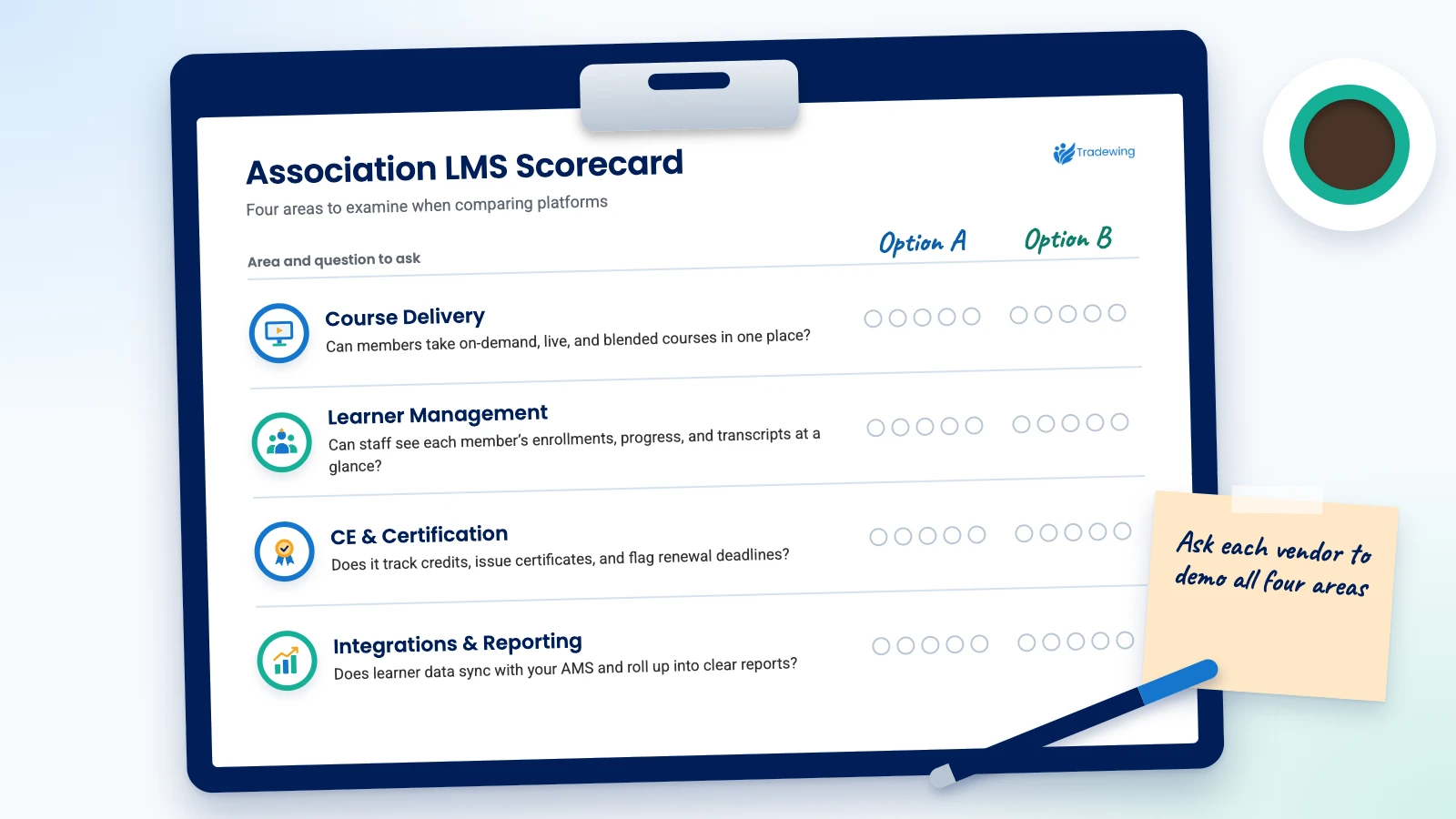
Learning management systems primarily deliver and track education. Continuing education software manages credit-related requirements, while certification management software supports the administration of professional credentials.
The categories overlap, but understanding their primary responsibilities can prevent an association from purchasing software that addresses only part of its needs.
| Software category | Primary responsibility | What buyers should verify |
|---|---|---|
| Learning management system | Deliver courses, manage enrollment, administer assessments, and maintain learning records | Does it support the required learning formats, assessment rules, and recordkeeping? |
| Continuing education software | Manage eligible educational activities, credit requirements, documentation, and reporting | Can it apply the credit rules and reporting requirements relevant to the association’s programs? |
| Certification management software | Administer professional credentials, including eligibility, examinations, renewals, and recertification | Does it support the complete credential lifecycle and required governance processes? |
Some vendors combine these responsibilities. Others specialize in one area or integrate with complementary systems.
The distinction is especially important when evaluating certificates and certifications.
A certificate of completion generally documents that a person completed a learning activity. An assessment-based certificate indicates that the participant demonstrated specific learning outcomes through an assessment associated with the educational program.
Professional certification has a different purpose. It assesses whether an individual meets established standards of knowledge, skills, or competence, potentially including ongoing credential maintenance.
The Institute for Credentialing Excellence explains these distinctions in its guidance on assessment-based certificates and certification programs.
For an association issuing completion certificates after online courses, a conventional LMS may provide sufficient functionality.
An organization administering a professional credential may need additional systems or capabilities for eligibility reviews, examinations, credential expiration, and recertification.
When a vendor says its software supports certification, ask which processes it actually manages. Issuing a certificate after a course is not equivalent to administering a professional certification program.
An association LMS should work with the membership information needed to manage enrollment, pricing, and access. The appropriate integration depends on which system owns the member record and what information must move between platforms.
An association management system (AMS) may already maintain member status, contact information, dues, and membership categories. Separate systems may manage education, payments, events, and credentialing.
Consider a member who enrolls in a course at the member rate. Their membership expires before they complete it.
What should happen next?
The answer depends on the association’s policies. The member may retain access to a purchased course, lose access to a member-only benefit, or receive a renewal prompt.
Whatever the policy, the technology needs to support it without leaving staff to reconcile conflicting records manually.
This is where integration details matter.
Ask vendors to demonstrate the following:
Single sign-on (SSO) deserves separate attention. It may allow members to access multiple systems using the same credentials, but it does not necessarily synchronize membership records, course completions, or CE credits.
The buying team should distinguish authentication from data integration.
Tradewing examines a related issue in How to Evaluate Member Engagement Software Without Replacing What Works. An association may have good reasons to retain technology that already performs its intended function while adding specialized capabilities elsewhere.
The goal is to establish clear responsibilities across the technology environment, rather than create another system staff must manage independently.
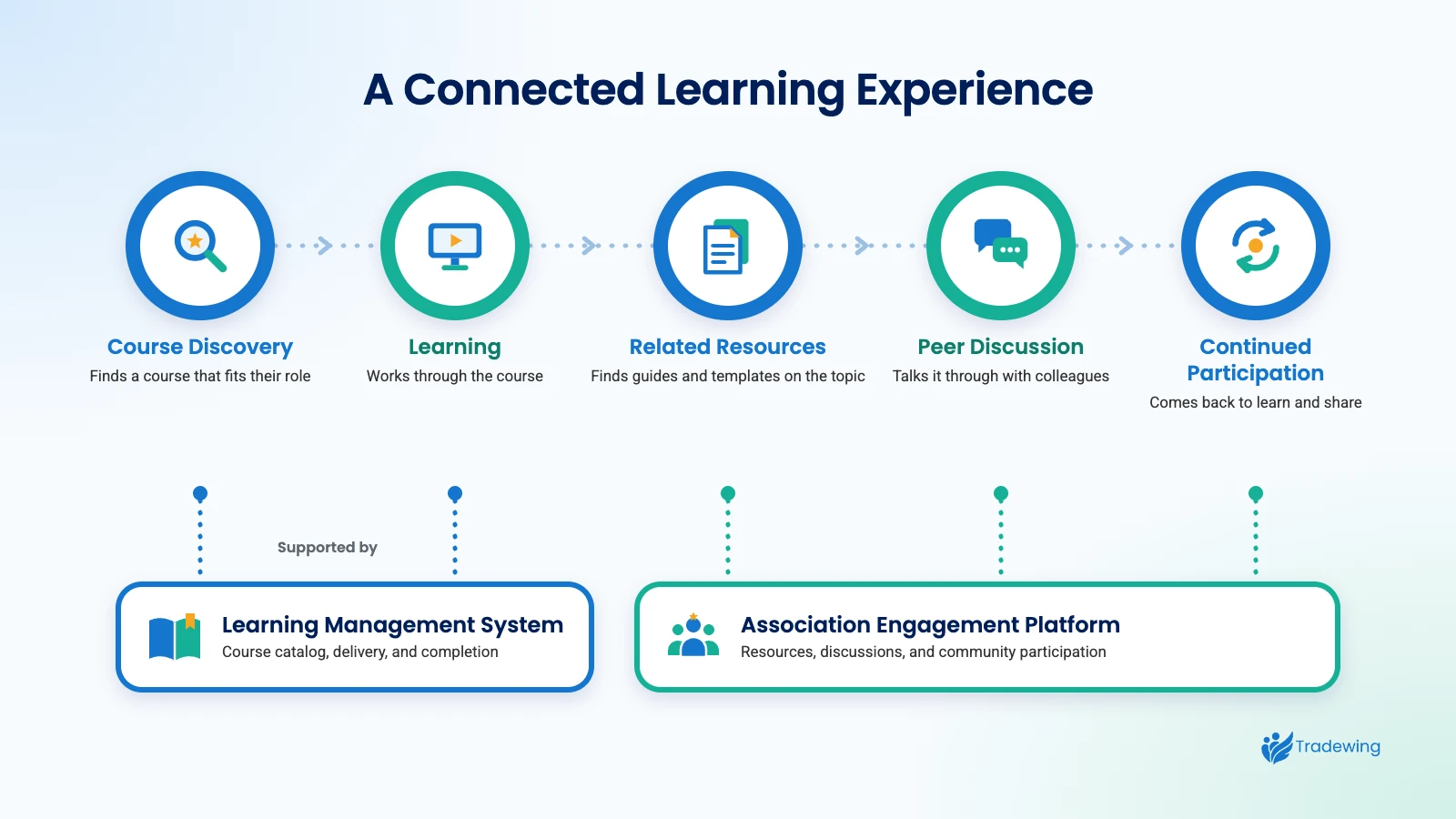
A standalone LMS may be the stronger choice when specialized course administration or complex learning requirements take priority. A connected learning approach becomes more relevant when an association also wants education to contribute to broader member participation.
The distinction is easier to understand by considering what happens after a course.
Imagine a member completing training on a new industry regulation. They understand the material, but applying it at work raises questions the course did not address.
They may benefit from discussing those questions with peers, reviewing related resources, or attending a follow-up event.
The association might already provide those opportunities. The question is whether members can discover them as part of their learning experience.
A connected approach can help associations bring education closer to the community, events, and resources they already offer.
| Decision factor | Dedicated LMS | Connected learning |
|---|---|---|
| Education administration | Specialized course and learner management | Depends on the underlying LMS |
| CE and certification | May offer advanced credentialing capabilities | Requires appropriate learning and credentialing tools |
| Member experience | Primarily course-centered | Learning alongside community, events, and resources |
| Community and events | Built in or available through integrations | Part of the broader engagement experience |
| Reporting | Primarily LMS learning records | Cross-system visibility depends on integrations |
| Implementation | LMS setup and required integrations | Coordination across learning and engagement systems |
These are approaches, not mutually exclusive product categories. Some dedicated LMS platforms include community features. Others connect effectively with association engagement platforms, AMS products, and specialized credentialing systems.
For an association whose primary requirement is managing complex assessments and formal credentials, specialized education functionality may deserve greater weight.
For an organization expanding professional development to encourage members to connect, share knowledge, and return between events, the surrounding member experience may be equally important.
The decision should reflect the association’s education strategy, administrative capacity, and the kind of participation it wants to support.
Tradewing offers Association Learning Communities powered by our integration with Intuto LMS. The arrangement combines Intuto’s structured course functionality with Tradewing’s broader association engagement environment.
Intuto provides the learning management component, including course management and learning activities. Tradewing supports the surrounding member experience, where associations can also offer community discussions, events, and relevant resources.
The integration connects course registration and access through Tradewing, while courses are managed in Intuto.
For an association, this creates opportunities to make learning part of a more continuous professional development experience.
A member completing a course might want to discuss an industry challenge with colleagues, explore related resources, or join a relevant event. Making those opportunities easier to discover can help the association extend the value of its educational programming beyond course completion.
For associations developing paid education programs, connecting learning with community can create more opportunities for members to discover relevant courses. A discussion about an emerging industry issue, for example, might lead members to a related workshop or online course.
That creates a potential path from participation to enrollment and non-dues revenue, provided the education addresses a genuine need. Associations should also verify how course purchases, member pricing, and enrollment are supported in their proposed configuration.
Associations with complex CE or credentialing requirements should likewise confirm the supported processes, integrations, and reporting capabilities before selecting a solution.
Learn more about Tradewing’s Learning & Certification capabilities and the Intuto LMS integration.
The most effective LMS demonstrations follow the workflows an association actually needs to support.
A general product tour may show what the platform can do. A scenario-based demonstration reveals how it would work for the education team and its members.
Ask shortlisted vendors to complete the same practical tests.
For example, have each vendor demonstrate how a member enrolls in a course, completes an assessment, and retrieves proof of completion.
If CE credits are important, ask how eligibility, credit assignment, and documentation are handled.
If learning access depends on membership status, test what happens when that status changes.
For paid courses, follow the process from purchase through enrollment and completion, including any relevant payment and pricing rules.
Implementation deserves the same scrutiny. Moving learning programs may involve course migration, historical records, integrations, testing, staff training, and ongoing support.
Before making a decision, confirm that the proposed solution meets your requirements in these areas:
Some requirements may remain unresolved after the first demonstration.
A vendor might need to confirm an integration field, demonstrate a specific report, or explain whether a workflow requires additional configuration.
Resolve those questions before signing, particularly when they affect the association’s costs, staff responsibilities, or ability to maintain essential records.
A useful final comparison should distinguish capabilities demonstrated in the proposed configuration from features mentioned in marketing materials or planned for future development.
The best association LMS is one that meets the organization’s education, credentialing, and integration requirements without introducing unnecessary administrative work.
Associations delivering primarily self-paced courses may prioritize simple course administration, learner access, and completion tracking. Organizations managing professional certification and recertification programs should place greater weight on specialized credentialing requirements.
The best choice is determined by those operational needs, not by the length of a vendor’s feature list.
Association LMS costs typically depend on the pricing model, learner volume, required functionality, integrations, and implementation scope.
A proposal may include subscription fees, setup, migration, optional modules, and ongoing support. Paid learning programs may also introduce payment processing or transaction costs.
Request a breakdown of one-time and recurring expenses, including what happens to pricing as enrollment or program complexity grows.
Yes, some association LMS platforms support continuing education credit tracking, completion records, and related documentation.
However, the ability to issue credits does not automatically mean a platform supports every accreditor’s requirements. Associations should verify credit rules, documentation, reporting, and any required integration with credentialing systems.
Yes. Many LMS solutions support paid education directly or through payment integrations.
Associations should verify member and nonmember pricing, payment processing, enrollment rules, refunds, and applicable fees.
Course revenue is most likely to be sustainable when the education addresses a clear professional development need and the association has the operational capacity to maintain the program.
Tradewing offers Association Learning Communities, an optional add-on powered by Intuto LMS.
Intuto provides structured online learning functionality, while Tradewing connects course registration and access with a broader association engagement experience that includes community, events, and member resources.
The precise learning, integration, and reporting capabilities depend on the proposed configuration.
Before comparing final proposals, identify the three or four learning workflows your association cannot afford to compromise on.
For an organization administering professional credentials, these may involve assessments, CE documentation, and recertification. For an association expanding its education catalog, the priorities may be course administration, member access, paid enrollment, and integration with existing systems.
Ask vendors to demonstrate those workflows and document any requirements that depend on additional products, configuration, or services.
That gives the buying committee a defensible basis for its recommendation and a clearer picture of what the selected platform will need to deliver after launch.

Petreysha is a Business Development Associate at Tradewing, partnering with associations to strengthen member engagement, build connected communities, and modernize the member experience through technology that supports long-term growth.

The next course your association offers might begin with a question in…
November 12, 2026
When an association begins looking for member engagement software, the frustrations behind…
October 30, 2026
While member dues have traditionally served as the financial backbone of professional…
October 20, 2026