Best Practices for Smooth Association Member Onboarding
Streamlining association member onboarding enables early engagement, reinforces membership value, and lays…
October 1, 2026
Annual dues used to be the financial foundation for associations, but with rising costs, changing member expectations, and unpredictable economic conditions, relying too heavily on dues can leave your organization exposed when membership growth slows or renewals decline.
For your association to survive and thrive in the face of economic challenges, you’ll have to embrace diverse income streams. But sustainable monetization isn’t simply about finding more things to sell. The strongest strategies build on value your association already creates through education, events, industry expertise, professional development, and corporate partnerships.
In this article, we’ll cover some of the best association monetization strategies that can strengthen financial resilience and tips on how you can implement them to secure financial sustainability:

Embracing non-dues revenue streams offers a wide array of benefits to your association. In particular, it:
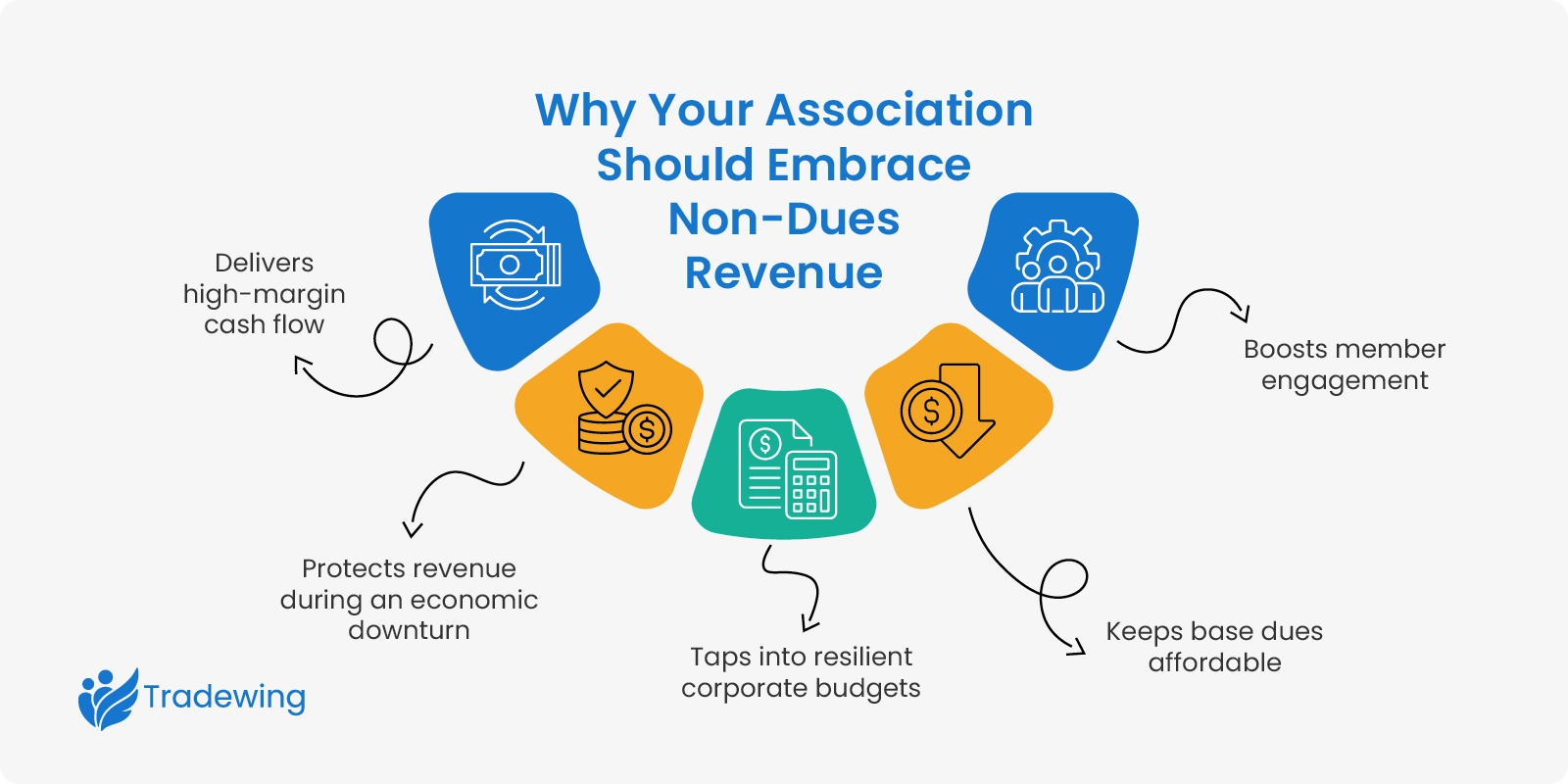
Cultivating non-dues revenue can also help you expand your market because it allows you to target the broader industry rather than just your closed community. Selected education, research, events, and professional resources can be offered to the broader industry, creating new revenue while giving prospective members another way to experience the value your association provides.
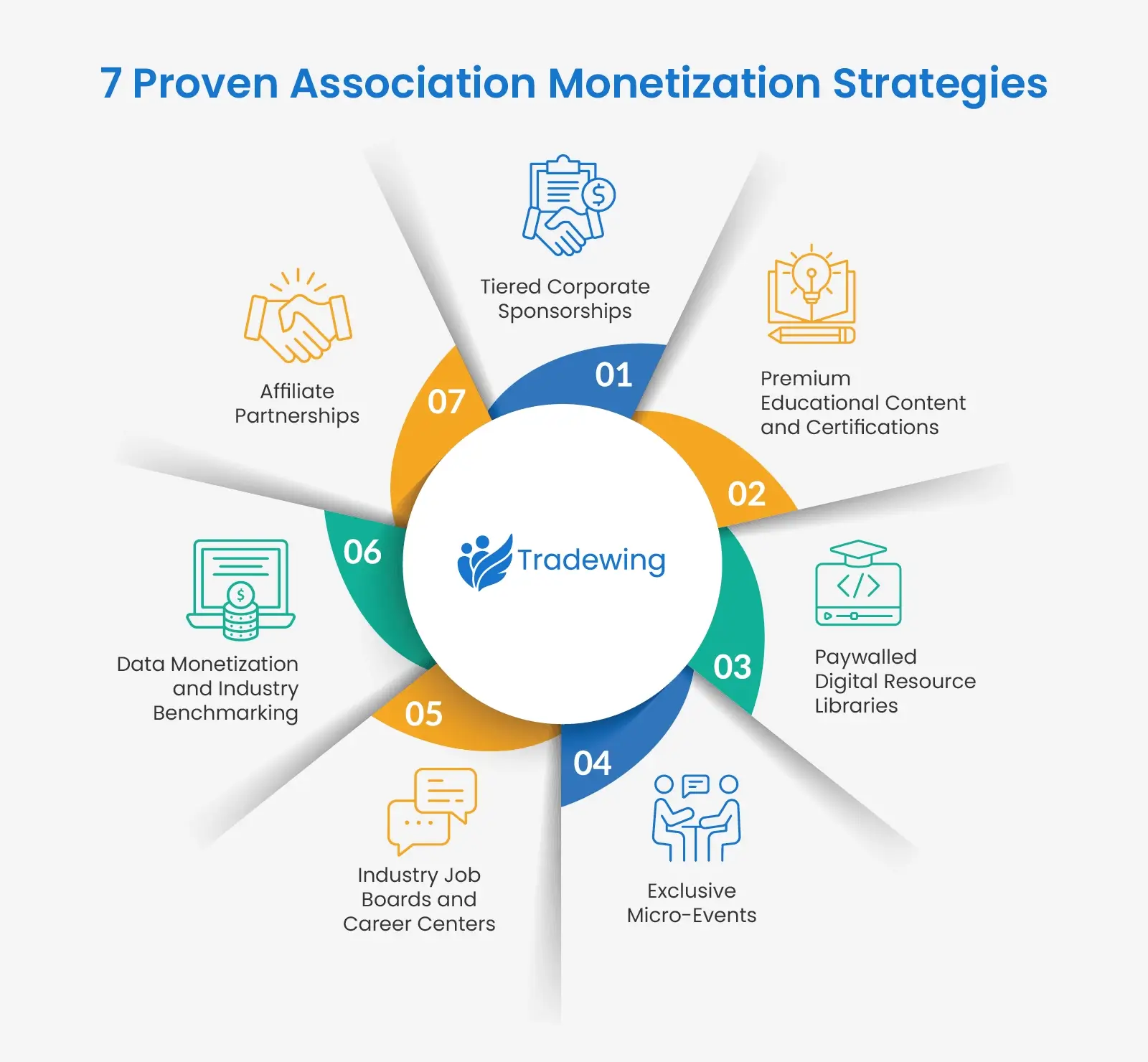
Corporate sponsorships are one of the most lucrative non-dues revenue streams for associations. But to attract and to retain corporate partners, you need to go beyond the usual strategy of slapping their logos in marketing materials and event merchandise. Rather, you should offer dynamic engagement opportunities, such as:
To retain these partners, commit to concrete ROI reporting. Sponsors want to know whether partnering with your association generates a profit for them, so promise them a comprehensive post-campaign report. Depending on the activation, this could include registrations, attendance, content engagement, resource downloads, discussion participation, leads, or repeat interactions with members.
Over time, these engagement signals give associations a clearer picture of how members are actually interacting with corporate partners, not simply how many times a sponsor’s logo was displayed. With the right technology in place, associations can capture these interactions across events, learning, community, and sponsor experiences and provide partners with more meaningful reporting.
Professionals are always seeking specialized knowledge to advance their careers. You can deliver more value by creating specialized learning opportunities for members, non-members, and employers willing to pay for deeper expertise or recognized credentials, such as:
You also may not have to start from scratch. Past conferences, webinars, educational resources, and recurring member questions can reveal topics worth developing into structured learning products. Look at what members already engage with to identify where deeper educational demand may exist.
Your association possesses years of institutional knowledge, specialized resources, recordings, and other educational materials. In addition to selling courses and certification tracks, you can offer other resources that professionals may need. These resources can include compliance checklists, legal contracts, industry-specific calculators, and standard operating procedures (SOP) manuals.
These resources help professionals and companies save time, making them a smart sell. If you choose to offer these premium assets, be sure to organize them into a searchable digital vault.
The goal, however, shouldn’t be to place as much existing content as possible behind a paywall. Focus on resources that provide clear additional value, especially tools that save professionals time, support decision-making, or help them perform their jobs more effectively.
Though annual conferences and trade shows offer valuable experiences to members, they also require immense logistical effort and high overhead costs. Instead of relying solely on these major gatherings, you can host exclusive micro-events. Micro-events are small-scale and relatively short, making them perfect for fostering deeper connections.
Micro-events come in various types and formats, such as:
To ensure your micro-event is a success, target specific personas within your broader industry. For example, if you’re a healthcare association, plan one micro-event for nursing assistants and another for registered nurses. The more specific the audience and professional need, the easier it becomes to create an experience participants consider worth paying for—and one sponsors may see value in supporting.
Employers often struggle to find qualified, specialized talent. If you have a job board or a career center, they may be willing to pay premium fees to be able to post openings or access your resume database of qualified association members.
This works particularly well when monetization aligns with a genuine member need: employers gain access to specialized talent while members gain access to career opportunities relevant to their profession.
Be sure to promote your career center or job board in your email newsletter and on your social media channels. That way, you’ll attract both employers looking for qualified candidates and job seekers who may be interested in joining an association for your career opportunities.
Your association may already collect valuable industry knowledge through surveys, research, educational programs, events, and member activity. This can reveal insights into areas such as compensation and workforce trends, skills gaps, technology adoption, and emerging industry challenges.
When handled with appropriate privacy protections and aggregated responsibly, these insights can inform benchmarking reports, salary surveys, trend forecasts, and other research products that organizations may be willing to purchase.
Engagement intelligence can also help your team understand which topics, resources, and professional needs are generating interest across your membership. Rather than treating those signals as a product to sell, use them to identify where demand exists and inform the research, education, events, and programming you develop next.
Your members continuously purchase software, insurance, and other services related to their profession. Take advantage of this opportunity by partnering with businesses that offer services your members need or already use. For example, if most of your members use a specific scheduling software, reach out to that vendor to discuss forming an affiliate partnership.
This partnership works by having you promote the product or service to your members, and in return, you’ll earn a commission for every sale, lead, or click generated through these marketing efforts.
The key is relevance. Affiliate partnerships should begin with products or services that genuinely support members’ professional needs rather than simply selecting the vendor offering the highest commission. Revenue should be the result of creating member value—not the other way around.
Executing a new revenue model requires precision and careful strategic planning. When implementing your monetization strategies, follow these steps:
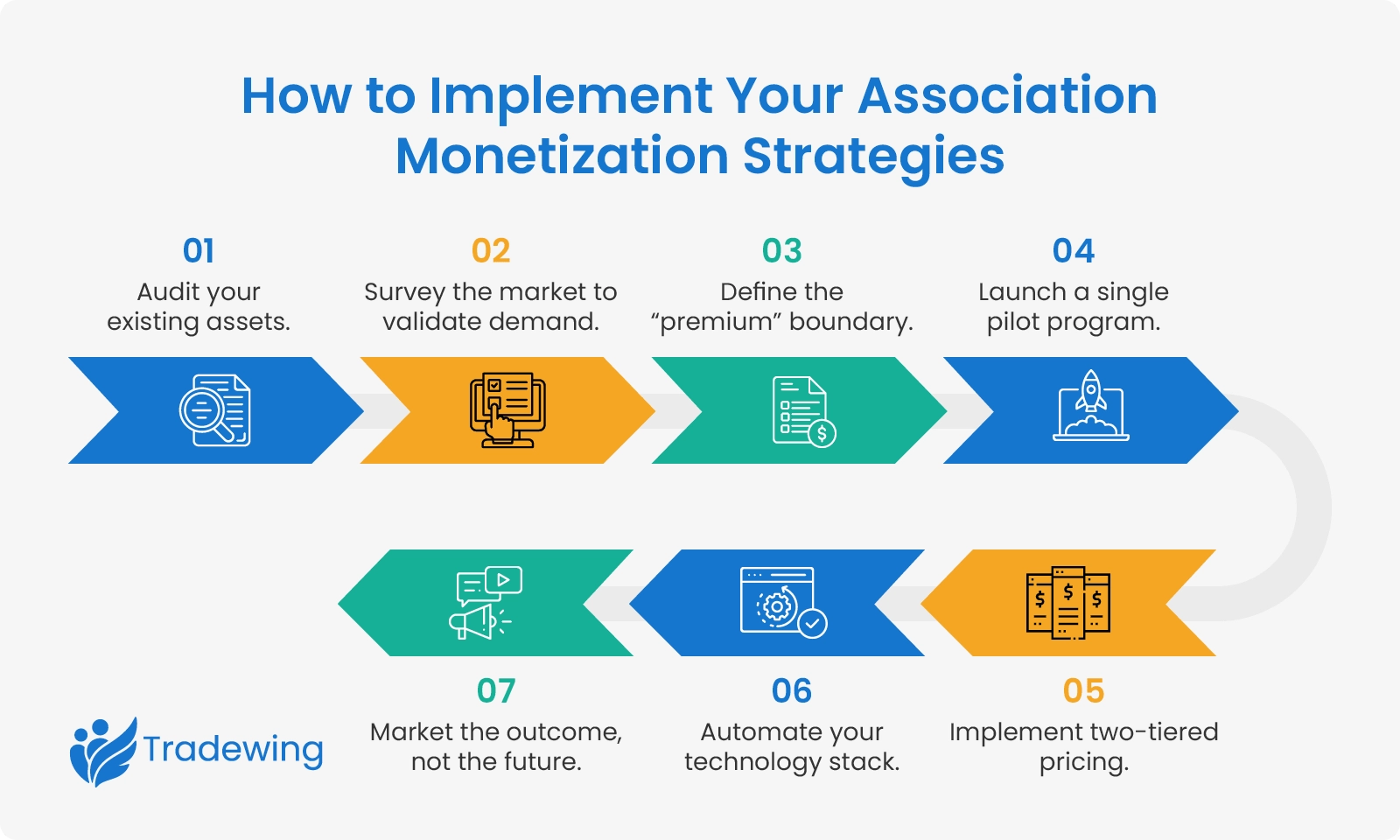
To ensure you’re not alienating your members when offering paid products and services, prioritize transparency. Monetization should never make members feel that core value is being stripped away and resold. Clearly communicate what the new offerings are and how you will reinvest the new revenue streams in your association. When you provide this information, your members won’t feel like you’ve nickel-and-dimed them, and they’ll purchase paywalled offerings if they see value.
You can offer the most valuable assets and services to professionals in your industry, but if your technology stack is fragmented, it creates a disjointed experience for the users, which may cause them to abandon your association altogether.
When education lives in one system, events in another, sponsor activity somewhere else, and member conversations on a separate platform, both staff and members experience the effects of that fragmentation. It becomes harder to understand which experiences are creating value, where engagement is growing, and what opportunities should come next.
To prevent this friction, you must integrate your AMS and LMS with your broader engagement infrastructure, which typically includes:
To give you a better idea of how an engagement infrastructure works, consider this sample scenario: let’s say you released an exclusive webinar on how to properly use AI tools in your industry. In the webinar video itself, there will be a live chat box, enabling attendees to ask speakers questions in real time, and when the class finishes, they can seamlessly transition to a discussion thread dedicated to the same topic. There, they can discuss their thoughts with fellow attendees and even debate some points. If they want to revisit the webinar, they can easily access it in the resource library right on the same platform.
With connected engagement infrastructure, the association can recognize that pattern and use it to inform future programming, educational products, member communications, and even relevant sponsorship opportunities.
That’s where monetization becomes more sustainable: instead of continually guessing what to sell next, your association can use actual engagement signals to understand where members and industry professionals are already finding value.

Traditional sponsorships involve passive brand visibility, such as printing a logo on a conference banner, lanyard, or other type of association merchandise. On the other hand, an integrated corporate partnership entails deep, ongoing collaboration for the association and the sponsor. Typically, these collaborations involve co-creating valuable content across multiple member touchpoints—such as education, events, resources, or industry conversations—over a longer period.
You can prove your ROI to your corporate sponsors by tracking concrete digital engagement metrics. For example, if your sponsor created a webinar, provide a detailed report on the webinar’s attendance numbers, content engagement, leads, discussion participation, or repeat interactions. These signals provide a more complete picture of sponsor value than visibility metrics alone.
There isn’t one universally most profitable non-dues revenue stream. The right model depends on your audience, existing assets, staff capacity, pricing, and cost of delivery. Digital education and research can offer attractive margins because they may be distributed at scale, while corporate partnerships can generate significant revenue when your association can demonstrate meaningful access and engagement.
If your association has a small staff, start small when launching a new revenue stream to avoid overwhelming everyone. Focus on a single pilot program first, then gauge how well it performs. Prove the concept works before committing more resources to complex non-dues offerings.
To support your association’s monetization strategies, you’ll need an integrated, modern technology stack. The essentials include your association management system (AMS), a secure payment gateway, and a robust engagement platform. These tools must communicate seamlessly to ensure smooth checkouts, instant content delivery, continuous engagement, and a complete database.
Scaling your association requires a shift away from stagnant dues-only models toward dynamic, year-round engagement. You should identify where your association already creates meaningful value and find responsible ways to extend, package, and monetize that value.
When those offerings are connected through a shared engagement infrastructure, associations can better understand how members, learners, event attendees, and corporate partners interact across the organization, and use those insights to create stronger experiences and more sustainable revenue.
Tradewing provides the engagement infrastructure needed to connect your systems, encourage continuous participation, and deliver trackable ROI to sponsors. Transform your community growth into a sustainable system today.
Continue exploring strategies and technology for building stronger year-round member engagement::


Rhona is a Marketing Specialist at Tradewing, creating content and campaigns that help associations strengthen member engagement, simplify communications, and support long-term growth.

Streamlining association member onboarding enables early engagement, reinforces membership value, and lays…
October 1, 2026
For lean association teams, dues collection can create more administrative work than…
September 21, 2026
Did you know that many professional organizations experience a severe drop-off in…
September 8, 2026