Monetization Strategies for Your Association Community
While member dues have traditionally served as the financial backbone of professional…
October 20, 2026
Member onboarding is a crucial yet often overlooked aspect of an association’s lifecycle. It is where the member experience begins, not where it ends. A strong onboarding journey helps new members understand their membership, find the people and opportunities most relevant to them, and experience value early.
For associations, that means going beyond a welcome email or orientation checklist. Effective onboarding should create a path from joining to participating, connecting new members with community, learning, events, resources, and relationships that give them a reason to keep coming back.
A smooth onboarding experience is a necessity for associations aiming to enhance retention and member engagement. In this article, we will discuss strategies that help associations create a more effective and member-centric onboarding process that drives long-term member satisfaction.

Onboarding transitions new members into becoming long-term valued members of your professional or trade community. New members are simultaneously the most engaged and the most vulnerable to churn in the first 30-90 days, so it is important to ensure that your onboarding process helps them feel confident in navigating their new environment instead of feeling overwhelmed. Effective onboarding offers several benefits to associations:
In essence, successful onboarding is the foundation of member satisfaction. To improve the onboarding process and increase early engagement metrics, look into membership management software. Technology can help associations make that journey easier to manage without making it feel impersonal. Tradewing connects member management and lifecycle automation with the experiences members actually participate in: community, learning, events, and more. That gives teams a way to automate routine onboarding steps while creating clearer paths into meaningful engagement.
Before embarking on the journey of optimizing your onboarding process, it’s important to understand the obstacles that often keep new members from fully engaging. Many associations encounter similar challenges, and if these issues remain unaddressed, they can significantly impact member satisfaction and retention:
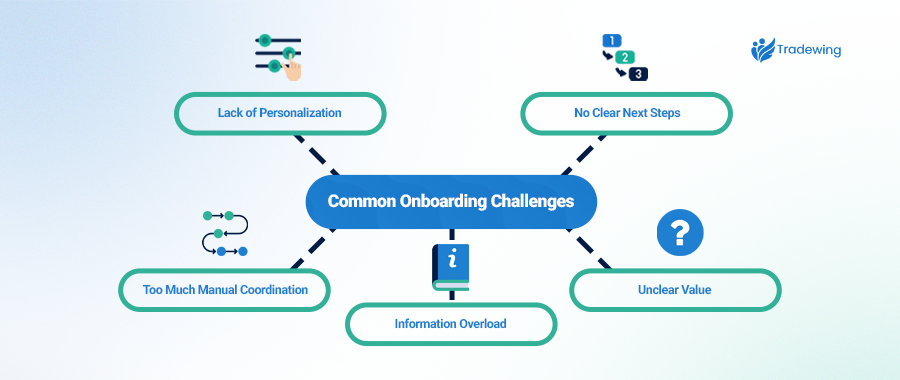
In an attempt to be helpful, associations often present new members with an overwhelming amount of content at once—emails, documents, links, and resources all arriving within the first few days. This can leave members feeling unsupported, unsure where to begin, and hesitant to engage at all.
While new members may understand what they receive with their membership, they may not comprehend how those benefits align with their specific goals. Without clear articulation or reinforcement of value early on, members may question the worthiness of their membership, particularly during the critical first 30 to 90 days.
Onboarding can quickly become labor-intensive when member records, email tools, community platforms, learning systems, and event technology operate separately. Staff may find themselves manually updating lists, sending reminders, moving data between systems, or checking several platforms simply to understand whether a new member has engaged. That administrative work takes time away from the human interactions that make onboarding valuable.
Treating all new members the same, regardless of their role, industry, or interests, can make the experience feel generic and disconnected. Tailored pathways are necessary to help members find their place within the community.
Even motivated members can stall if they’re uncertain about how to get involved. When onboarding lacks defined actions, such as joining a discussion, attending an event, or completing a profile, members may remain passive and lose interest.
A successful onboarding process requires thoughtful design to address these challenges effectively.
The most effective onboarding programs follow a well-defined journey, rather than relying on a single welcome email.
Begin by mapping out the key components of the onboarding journey:
This journey should feel progressive, gradually introducing concepts, tools, and opportunities rather than overwhelming the user with everything at once. You can use an automated email sequence to schedule emails that will alert new members to the next steps at the appropriate times with minimal administrative work, ensuring that everyone is on the same page. You can also build out an onboarding timeline in your membership portal, so new members can get an overview of how their onboarding experience will progress.
First impressions matter. When new members log in or access your online community for the first time, the experience should be intuitive and welcoming.
Best practices include:
The goal is to build confidence, not complexity. When members know exactly where to begin, they’re more likely to take the first step to explore your program further.
Not all members join for the same reason. Use a member engagement platform to segment onboarding based on role, industry, career stage, or interests to significantly improve member engagement.
Personalized onboarding can include:
Personalization lets new members know that your organization is invested in their professional success, and establishes a firm foundation for long-term support. If new members feel like their association is making an effort to get to know them, their professional history, and their specific needs, they’re more likely to return year after year.
Personalization doesn’t have to stop with what a member tells you when they join. As members begin participating, their activity can provide additional signals about what they value. The discussions they join, events they attend, learning they pursue, and resources they engage with can help inform what you surface next.
Automating some elements of your onboarding process doesn’t mean removing the human touch. Automation should handle the predictable parts of onboarding so staff can spend more time on the interactions and relationships that benefit from a human touch.
Automation works well for:
Include human outreach at impactful moments of the onboarding process, such as personal welcomes from leadership, mentorship or buddy programs, and live orientation sessions or Q&As. While automation can provide useful administrative assistance, it should never come at the expense of the human connection between members of your community.
Add a human touch for:
One of the fastest ways to optimize onboarding is to help members experience value quickly. Encourage simple, low-effort actions such as completing a profile, introducing themselves in a discussion, downloading a key resource, and attending a short welcome event or learning session, or making the first connection with a mentor. These “early wins” build momentum, get new members connected to your community quickly, and reinforce that joining was the right decision. The important thing is that the member experiences value rather than simply being told about it.
It’s easy to assume all of your members understand all of your association’s benefits. However, without clear explanation and value reinforcement, professionals may miss out on opportunities sitting right in front of them. Throughout onboarding, reinforce why each feature or resource matters, tie actions back to outcomes (learning, networking, career growth), and use simple language instead of internal jargon. When members can clearly articulate the value of their membership, satisfaction and retention increase.
Your onboarding development process should never be static. It’s important to regularly evaluate and refine your onboarding process based on completion metrics and collected feedback. Make sure to track metrics such as new member engagement rates, time until first interaction, event attendance within the first 90 days, community participation levels, and early retention rates. Additionally, send feedback surveys at the end of the first 90 days to evaluate how prepared your newest members feel based on their onboarding experience. When considering new ways to improve your onboarding program, pair these analytics with your member feedback to determine areas that need more support and identify creative ways to improve.
The goal of onboarding isn’t simply to get a member through their first 30, 60, or 90 days. It’s to help them find their place in the association. When the initial journey is intentional and member-focused, it transcends simple orientation to become a foundational step toward meaningful connection. This thoughtful approach builds immediate trust, reinforces your association’s unique value, and cultivates a deep sense of belonging
That might begin with completing a profile or attending a welcome event. But over time, those first steps should lead to something more: a useful conversation, a new professional connection, a learning opportunity, a mentor, an event, or a community they want to return to.
That’s where onboarding becomes part of a larger member engagement journey—and where connected Engagement Infrastructure can help associations carry the experience forward long after the welcome sequence ends.


Rhona is a Marketing Specialist at Tradewing, creating content and campaigns that help associations strengthen member engagement, simplify communications, and support long-term growth.

While member dues have traditionally served as the financial backbone of professional…
October 20, 2026
For lean association teams, dues collection can create more administrative work than…
September 21, 2026
Did you know that many professional organizations experience a severe drop-off in…
September 8, 2026