Monetization Strategies for Your Association Community
While member dues have traditionally served as the financial backbone of professional…
October 20, 2026
When an association begins looking for member engagement software, the frustrations behind the search are often familiar. Members email staff for recordings they cannot find, committee conversations are scattered across different tools, and the membership team spends hours assembling reports that still offer an incomplete picture of participation.
Meanwhile, the AMS may be doing its job. Dues are collected, renewals are processed, and membership records are maintained. Replacing it would be a substantial undertaking, particularly when the problems prompting the search sit elsewhere in the member experience.
Before comparing platforms, the association needs to distinguish between an administrative problem, a gap in how members participate, and a process that could improve without buying software. Those distinctions determine whether the right investment is an engagement layer, a specialist tool, an AMS replacement, or better use of the systems already in place.
A useful evaluation follows the work from both sides: what a member is trying to accomplish and what staff must do to make it possible. The framework below uses that approach to assess capabilities, integrations, reporting, implementation, and cost, with a scorecard to help the buying committee compare its findings.
This framework can be used to evaluate any vendor to assess improvements to your existing tools.
An ambition such as “improve engagement” can bring people together at the beginning of a project while concealing very different expectations. The Membership Director may be focused on first-year renewals, the Events Director on year-round member engagement, and Operations on the manual work required to keep member information consistent.
Before building a shortlist, bring those perspectives into the same conversation and identify the experiences the purchase needs to improve. Include the people who handle the work, since they are often best placed to explain where a seemingly simple member request becomes complicated.
Consider a member who attends a webinar and later contacts staff for a resource mentioned during the session. Following that experience may reveal that the resource was published in an unfamiliar location, that access permissions were incorrect, or that the event page did not link to the material. Each explanation leads to a different requirement, and some may be resolved within the existing setup.
Once the cause is understood, describe the task in terms a vendor can demonstrate:
Members need to find session materials from the event page, locate them again through search, and access the appropriate resources without contacting staff.
Give each shortlisted vendor the same scenario and record the steps required from both the member and administrator. This creates a more useful comparison than marking whether each product has a resource library.
Our member engagement platform guide provides background on the category. During evaluation, narrow those general capabilities to the work that matters for your association.
The scope of a technology project can expand quickly once demonstrations begin. A search for better community participation may become a proposal to replace membership administration, rebuild the website, and move learning programs at the same time. That broader project may be justified, but it needs its own evidence and business case.
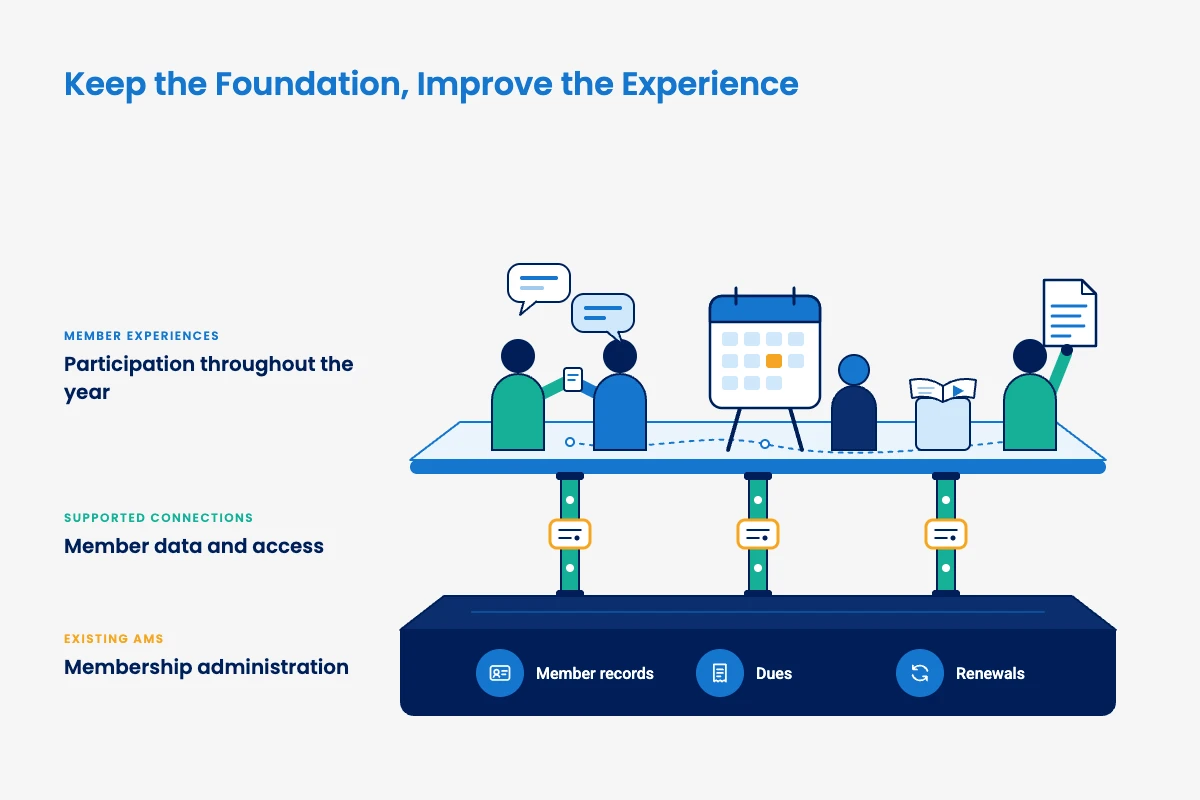
An Association Management System (AMS) typically serves as the operational system of record for membership and administration. An engagement layer supports activities such as community participation, events, learning, and knowledge sharing, with the connection between systems determining how member information and access are handled.
When the existing AMS supports membership structures, transactions, renewals, and essential reporting, retaining it can reduce disruption. The evaluation can focus on improving participation around that foundation, provided the proposed integrations support the association’s requirements.
Keeping the AMS does not remove the need for careful planning. Staff still need a clear source for membership status, agreed rules for access, and a way to resolve discrepancies between systems. An engagement platform should not leave the team maintaining two competing versions of the member database.
If essential administration is failing, assess replacement against those operational requirements. Adding an engagement layer will leave unresolved billing, membership, or reporting limitations in place.
The engagement infrastructure model can help separate these responsibilities. It also leaves room for a less extensive change: existing technology may be sufficient when the underlying issue is inconsistent programming, unclear invitations, or a community without an active owner.
| Current situation | Direction to evaluate |
|---|---|
| Existing tools work, but participation is low | Review programming, onboarding, and ownership before committing to new software |
| A program has a specialist requirement | Assess a specialist tool or an extension to the current system |
| Administration works, but member experiences are fragmented | Assess an engagement layer connected to the existing AMS |
| Essential membership administration is failing | Assess AMS replacement alongside the required engagement capabilities |
These approaches can coexist. An association may retain its AMS, introduce an engagement layer, and continue using a specialist system for a complex conference or learning program.
Events make a useful evaluation scenario because they bring several parts of the member experience together. A member discovers a session, registers, attends, meets a colleague, and returns later for a recording or discussion. Although each activity may work individually, the transitions between them can still be difficult.
The Society for Industrial and Organizational Psychology’s 2025 membership survey offers relevant context. Among respondents, 55% selected connection with the professional community as a reason for joining or renewing. The survey received 478 responses, approximately 7% of invited members, so the findings describe one society rather than associations generally.
For an evaluation team, this is a reason to include the relationships around an event in the demonstration. Follow an attendee through finding a relevant peer, accessing session materials, contributing to a discussion, and returning to that conversation later. Include a volunteer or chapter leader’s responsibilities so the team can see how groups are managed and how ownership transfers when someone steps down.
As the demonstration progresses, distinguish capabilities that can sound interchangeable in a proposal:
Document the capabilities required for your programs, whether they are included or optional, and any dependency on another provider. Where a specialist system supports a demanding requirement well, keeping it may be the more practical choice.
The preparation behind a demonstration is easy to overlook. Permissions have been configured, content has been uploaded, and sample records are ready for the presenter. After launch, those responsibilities become part of someone’s working week.
Include routine administration in the evaluation so the association can estimate that commitment. Have an administrator complete tasks such as:
For each task, record the training, manual steps, and outside support involved. This matters particularly for lean teams, where the person managing the platform may also be responsible for communications, events, and member support. A process that is manageable for a dedicated administrator can be difficult to sustain alongside those responsibilities.
Member effort deserves the same attention. Deloitte’s 2026 Gen Z and Millennial Survey found that 58% of Gen Z respondents and 54% of millennials reported digital fatigue from alerts, tool switching, and multiple platforms. This is workforce research rather than an association-member benchmark; it provides context for considering the demands a digital experience places on its users.
Test essential activities on the devices members use, including login, navigation, notifications, and accessibility. The decision between an association mobile app and a responsive website should follow those needs rather than a general preference for having an app.
For AI-powered knowledge discovery, use approved material from a representative resource library and include a request the sources cannot answer. Review the citations, permission handling, and process for correcting inaccurate or outdated information. The evaluation should establish how members can assess an answer and how staff can maintain the knowledge behind it.
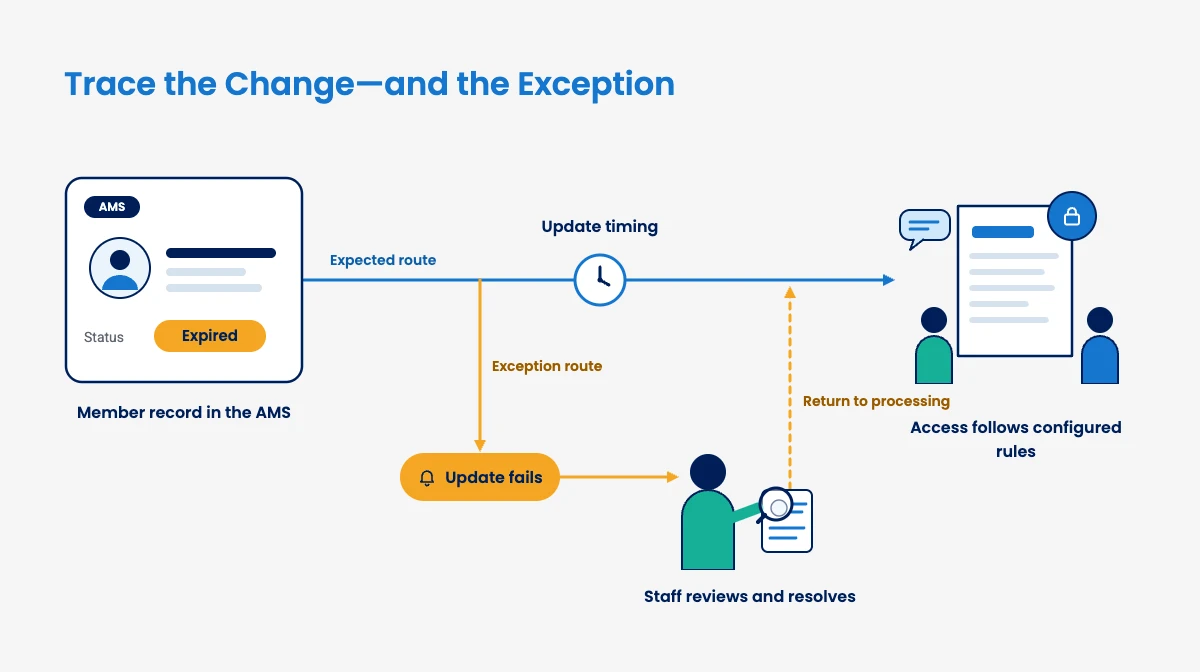
An integration directory is a starting point for identifying potential connections, but it rarely provides enough detail to confirm a workflow. The buying team needs to understand the data involved, how it moves, and what happens when an update fails.
A membership expiration provides a practical test. Follow the status change from the AMS through the integration to the connected platform, including its effect on restricted groups, resources, or courses where those rules apply.
| Stage | Evidence to review |
|---|---|
| Membership expires in the AMS | The authoritative status field and the team responsible for maintaining it |
| The integration processes the change | Data direction, update frequency, failure logs, and recovery process |
| Access changes in the connected system | The resulting permissions and the staff process for resolving incorrect access |
Bring the AMS partner or IT contact into this discussion, particularly when the connection depends on configuration or services from more than one provider. Document which fields synchronize, the direction and frequency of updates, and responsibility for maintaining the integration.
Apply the same care to learning records. If CE credits or certifications must appear in member profiles, include that exact process in the demonstration and written scope. The presence of an LMS integration alone does not establish that those records will synchronize.
Before signing, reconcile the proposal with what was demonstrated. Limitations, dependencies, implementation fees, ongoing charges, and support responsibilities should be documented while the association can still assess their effect on the decision.
A member analytics dashboard can display substantial activity without helping the membership team decide where to focus. The evaluation needs to connect reporting to an actual responsibility, such as supporting new members, improving a program, or preparing a sponsor report.
Naylor’s 2026 Association Benchmarking Report identified using data for strategic decisions as a challenge for 47.7% of respondents. The study received 665 responses from senior association professionals across North America.
Bring a reporting task your team already needs to complete. This might involve identifying new members with no recorded participation, reviewing whether event attendees return for other activities, or finding resources that attract repeat use.
Have the vendor produce the report, then review the details that determine how staff can interpret it:
Sponsorship reporting benefits from the same approach. Generating non-dues revenue was a challenge for 51.9% of respondents in Naylor’s study. If sponsorship is part of the project, select a benefit the association intends to offer and trace how it would be delivered and measured.
Keep exposure, interactions, leads, and revenue distinct when assessing those reports. An engagement score also needs an appropriate use: it may help staff identify members or programs for further attention without establishing why participation changed or predicting an individual renewal.
The subscription price is usually the most visible figure in a proposal, while the commitments surrounding it take more work to compare. A realistic assessment includes the services, retained systems, and staff responsibilities needed to operate the proposed configuration.
One vendor may include migration and training while charging separately for learning or video. Another may include additional modules but expect staff to prepare data and configure workflows. Assess each arrangement against the association’s capacity and compare proposals over the same contract period.
Separate first-year expenses from ongoing costs, including:
Migration deserves a defined scope before the association relies on an implementation estimate. Member records, discussions, resources, financial information, and permissions may require different treatment. Agree on what will move, what will remain elsewhere, who will prepare it, and how the result will be tested.
Review security, privacy, service reliability, data ownership, and exit arrangements alongside the commercial terms. Involve the appropriate internal reviewers and obtain documentation relevant to the association’s requirements.
Support should be equally specific. Establish the available channels, response expectations, escalation process, and division of responsibility between vendor and association staff. A reference customer can help put these commitments in context by describing unexpected work, support needed after launch, and changes they would make to their implementation approach.
By the end of the demonstrations, stakeholders may favor different products for understandable reasons. A scorecard makes those differences visible and gives the committee a consistent basis for discussing them.
Agree on the criteria and their importance before scoring the shortlisted options. Include the people responsible for membership, events, operations, technology, and budget approval, as appropriate to the project.
Our Association Engagement Platform Buyer Checklist provides a worksheet for defining priorities, recording evidence, and comparing up to three vendors. Use it alongside the practical tests below, adapting the criteria to the association’s requirements.
| Evaluation area | Practical test |
|---|---|
| AMS and integrations | Follow a status change through connected systems and review failure handling |
| Member and staff experience | Complete a priority member journey and the administration behind it |
| Community and networking | Find a relevant peer and manage a group with appropriate permissions |
| Events, learning, and mentorship | Demonstrate required program workflows and identify add-ons or external services |
| Knowledge discovery | Find approved information and handle an unsupported request appropriately |
| Analytics and sponsorship | Complete a reporting task and explain the measures used |
| Mobile and accessibility | Complete essential tasks on relevant devices using required accessibility features |
| Implementation and support | Provide a scoped plan with responsibilities, training, and escalation arrangements |
| Security, privacy, and data ownership | Supply relevant documentation and demonstrate permissions and export options |
| Total cost | Itemize the subscription, services, dependencies, and ongoing administration |
The checklist uses a five-point rating scale and a separate priority weight for each evaluation area:
| Rating | Meaning |
|---|---|
| 1 | Poor |
| 2 | Limited |
| 3 | Acceptable |
| 4 | Strong |
| 5 | Excellent |
| NE | Not evaluated; use when evidence is insufficient |
Assign each area a priority of High (3), Medium (2), or Low (1) before comparing vendors. Keep notes on the demonstrated configuration, limitations, costs, and workarounds beside each rating so the committee can understand the evidence behind it.
Calculate the weighted percentage as:
Weighted score = [sum of (rating × priority weight) ÷ (5 × sum of evaluated priority weights)] × 100
Exclude areas marked NE from both parts of the calculation. Because the percentage reflects only evaluated areas, review evidence coverage alongside the result. A vendor with several unresolved areas should not appear stronger simply because those areas were left out.
Treat essential requirements as separate decision gates. A high overall score cannot compensate for an unsupported must-have, and roadmap commitments should remain distinct from functionality available for launch. Include the current setup in the comparison so the committee can assess the practical value of making a change.
Once a platform makes the shortlist, a conversation with a comparable association can help fill in details that a demonstration leaves open. Look for similarities in staffing, membership structure, programs, and existing systems, since those factors influence how much work implementation and ongoing administration will require.
Use published customer stories to prepare for that conversation. For example, ASTA’s experience with Tradewing describes renewal automation alongside membership and revenue growth. A prospective buyer could explore how renewal responsibilities changed, what staff continued to handle, and how marketing and pricing changes contributed to the reported results.
The most useful reference conversations leave the team with a clearer understanding of the work involved: what took longer than expected, which limitations required adjustments, and how support worked after launch. Keep those findings alongside the scorecard so the final recommendation reflects both demonstrated capabilities and the experience of operating the platform.
A recommendation to leadership should make the proposed member experience and operating commitment understandable together. It needs to explain the improvement, the systems that will remain, the responsibilities staff will take on, and the limitations the association is prepared to accept.
That recommendation may involve improving programming within current tools, adding a specialist product, connecting an engagement layer, or replacing an AMS. A thorough evaluation gives the committee evidence for choosing the scope of change and a realistic basis for planning what follows.
Tradewing provides Engagement Infrastructure for associations seeking connected community, events, knowledge sharing, sponsorships, and engagement analytics. It can work alongside an existing AMS, with integration and membership-administration requirements assessed against the proposed configuration. Intuto-powered Learning Communities, Structured Mentorship Programs, and built-in video conferencing are optional add-ons.
If Tradewing makes the shortlist, use the product tour, integration directory, and Engagement Intelligence overview to prepare a demonstration around the association’s priorities.
For teams still defining the project, an Engagement Audit can help examine a member journey and the systems supporting it. The aim is to identify improvements that make participation easier while preserving the tools and processes that continue to serve the association well.

Petreysha is a Business Development Associate at Tradewing, partnering with associations to strengthen member engagement, build connected communities, and modernize the member experience through technology that supports long-term growth.

While member dues have traditionally served as the financial backbone of professional…
October 20, 2026
Streamlining association member onboarding enables early engagement, reinforces membership value, and lays…
October 1, 2026
For lean association teams, dues collection can create more administrative work than…
September 21, 2026